Thyroid Function Tests and Thyroid Disorders (USMLE Step 1)
Most thyroid questions on USMLE Step 1 are solved with three numbers: TSH, free T4 and T3, plus the radioiodine uptake scan when the patient is hyperthyroid. The table below shows the lab pattern for every disorder you are likely to meet. Then try 32 practice questions, each with a written explanation of why the answer is right and why every other option is wrong.
Thyroid function tests at a glance: TSH, free T4, T3 and uptake
Hypothyroidism vs hyperthyroidism on labs
Primary disease moves TSH the opposite way to the hormone: hypothyroidism = TSH up, T4 down (T3 often still normal); hyperthyroidism = TSH down, T3 and T4 up. TSH is the best initial test; free T4 confirms. If TSH and T4 move the same way, think of the pituitary: both low is secondary hypothyroidism.1,2,3,4,5
Swipe the table sideways to see T3 and uptake.
| Disorder | TSH | Free T4 | T3 | Uptake |
|---|---|---|---|---|
| Hashimoto6,7Anti-TPO, anti-Tg; lymphocytes | High | Low | Normal or low | Low or patchy |
| Subclinical hypothyroid8Treat if TSH >10, TPO+, pregnancy | High | Normal | Normal | · |
| Graves9,7TSI; exophthalmos, pretibial myxedema | Low | High | High | High, diffuse |
| Toxic adenoma10,7Hot nodule, rarely malignant | Low | High | High | High, one focal nodule |
| Toxic multinodular goiter10,7Older adults | Low | High | High | High, multifocal |
| de Quervain (hyper phase)11Tender gland; NSAID | Low | High | High | Low |
| Postpartum / silent12,13Painless, within 1 year of delivery | Low | High | High | Low |
| Drug (lithium, amiodarone)13NBME: usually hypo | High or low | Low or high | · | Low, if hyper |
| Taking T4 (levothyroxine)10,14Small gland, no tenderness | Low | High | High | Low |
| Taking T3 (liothyronine)14,4T3 does not make T4 | Low | Low | High | Low |
| Euthyroid sick15Reverse T3 ↑; ICU, surgery | Normal | Normal | Low | · |
| Pregnancy14Total T4 ↑ (TBG ↑ by estrogen) | Normal | Normal | · | · |
| TBG deficiency16Total T4 ↓ | Normal | Normal | · | · |
| Central hypothyroid4Sheehan syndrome | Low | Low | · | · |
| TSH-secreting adenoma5Rare; essentially never the answer | High | High | · | · |
Thyroid disorders: video walkthrough
Video coming soon
A walkthrough of all 32 questions will appear here.
Thyroid disorders practice questions
Try each question first, then open the explanation. Jump to: 1 2 3 4 5 6 7 8 9 10 11 12 13 14 15 16 17 18 19 20 21 22 23 24 25 26 27 28 29 30 31 32
Question 1
A 34-year-old woman comes to her family physician for a 3-month history of neck swelling and fatigue. She reports no weight change or cold intolerance. Her menstrual cycle over the past year has fluctuated between 28 and 33 days in length. Serum cholesterol and hepatic AST are elevated. Serum TSH, T3, and T4 are all within normal range. Antibody screening shows positive titers against thyroperoxidase and thyroglobulin. Physical examination shows a diffusely enlarged thyroid gland without nodularity. Which of the following is the most likely diagnosis?
Show answer and explanation
Correct answer: C. Hashimoto thyroiditis
The answer
The key clues are the antibodies against thyroid peroxidase, also called anti-microsomal antibodies, and against thyroglobulin. These are the classic antibodies of Hashimoto thyroiditis, and the diffusely enlarged thyroid is a goiter. Hashimoto is the answer even though TSH, T3 and T4 are all normal, because not every patient with thyroid disease has abnormal thyroid function tests.
Three more clues fit hypothyroidism. Serum cholesterol is raised, and high cholesterol is high yield for hypothyroidism. Hepatic AST is also raised; it seems odd, but thyroid dysfunction can cause raised transaminases. And her cycle length has varied between 28 and 33 days, and menstrual changes are a recognized feature of thyroid dysfunction.
Why A, B, D, E and F are wrong
A, anaplastic, and E, medullary thyroid carcinoma, are cancers that usually present as a thyroid nodule or neck mass, and this thyroid has no nodularity. B, Graves disease, causes hyperthyroidism through TSH receptor antibodies; none of its findings are here, and her antibodies target thyroperoxidase and thyroglobulin. D, Hürthle cell carcinoma, typically presents as a thyroid nodule, so it does not fit either. F, subacute granulomatous thyroiditis, gives a tender or painful thyroid, and this question describes no pain.
High-yield tips
★ High-yield tip #1
Hashimoto with normal thyroid tests
Classically in hypothyroidism, T3 and T4 fall and TSH rises because of the loss of negative feedback. So normal TSH, T3 and T4 seem strange for Hashimoto thyroiditis, but it is what the exam wants. Not every patient with thyroid disease has abnormal thyroid function tests, so keep that in mind.
★ High-yield tip #2
Other hypothyroid findings
Hypothyroidism can also cause a myopathy with proximal muscle weakness and raised creatine kinase, as well as depression and bradycardia, around 55 to 60. These are high yield, especially on Step 2 CK.
★ High-yield tip #3
No nodularity as an important negative
When a question lists no nodularity as an important negative, it is implying that this is not thyroid cancer. Anaplastic and medullary thyroid carcinoma usually present as a thyroid nodule or a neck mass, so a question that tells you outright there is no nodularity is steering you away from them.
★ High-yield tip #4
Anaplastic carcinoma
Anaplastic thyroid carcinoma is very rare. It typically affects older adults, and it can invade nearby structures such as the esophagus, causing dysphagia. Across the many thousands of NBME questions for Step 1 and Step 2, it has very rarely been the correct answer, so it is low yield.
★ High-yield tip #5
Medullary carcinoma
Medullary thyroid carcinoma is very high yield. It is part of MEN 2A and MEN 2B, often from a RET proto-oncogene mutation, and it can also run in families without the rest of the MEN picture. A question might simply say the patient, her brother and her father all had thyroid cancer, with nothing else. The answer is medullary thyroid carcinoma.
★ High-yield tip #6
Medullary carcinoma findings
For medullary thyroid carcinoma, raised serum calcitonin is classic. On biopsy, a Congo red stain shows apple-green birefringence because of amyloid, which is made of beta-pleated sheets.
★ High-yield tip #7
Graves disease
Graves disease causes hyperthyroidism, with classic findings such as a fast heart rate or heat intolerance. Activating antibodies bind the TSH receptor. They are called thyroid-stimulating immunoglobulins, or TSI, and this is a type II hypersensitivity reaction, which is very high yield.
★ High-yield tip #8
Do not pick the obscure option
Hürthle cell carcinoma is a deliberate distractor. When students don’t know an answer, they tend to pick the strange-sounding option. If you are unsure, don’t choose an answer just because it sounds obscure.
★ High-yield tip #9
De Quervain thyroiditis
Subacute granulomatous thyroiditis is also called subacute thyroiditis, or de Quervain thyroiditis. The question will always give you a tender or painful thyroid. Classically, a viral upper respiratory infection comes first, such as a runny nose for four days. But on harder Step 2 CK questions, the viral illness may not be mentioned, because not every patient reports one. Many do, 2 to 8 weeks before.
★ High-yield tip #10
Iodine uptake scans
The other high-yield point for de Quervain is that a radioactive iodine uptake scan is low, even if the patient is hyperthyroid. In a hyperthyroid patient, diffusely increased uptake fits Graves disease, a single focal area fits a toxic adenoma, and several nodules fit a toxic multinodular goiter. Hyperthyroidism with low uptake means thyroiditis: drug-induced, postpartum, or de Quervain, the painful one.
Sources: StatPearls: Hashimoto Thyroiditis; Endotext: Hashimoto’s Thyroiditis; Hashimoto’s Disease; MedlinePlus: Thyroid peroxidase antibody; StatPearls: Hypothyroidism; StatPearls: Physiology, Thyroid Hormone; StatPearls: Hypothyroid Myopathy; StatPearls: Sinus Bradycardia; StatPearls: Abnormal Uterine Bleeding; StatPearls: Medullary Thyroid Cancer; StatPearls: Anaplastic Thyroid Cancer; StatPearls: Graves Disease; StatPearls: Thyrotoxicosis; StatPearls: Type II Hypersensitivity Reaction; StatPearls: Oncocytic (Hurthle Cell) Thyroid Carcinoma; StatPearls: De Quervain Thyroiditis; StatPearls: Thyroiditis; StatPearls: Amyloidosis
Question 2
Ten days after a partial esophagectomy for adenocarcinoma, a 68-year-old man cannot be weaned from a ventilator. Chest is clear to auscultation. Vitals are within normal limits. Serum T4 is normal, serum T3 is low, and serum TSH is normal. Which of the following is the most likely explanation for these findings?
Show answer and explanation
Correct answer: C. Euthyroid sick syndrome
The answer
This man is ten days out from major surgery and cannot be weaned from a ventilator, so he is acutely ill. His labs show a normal T4, a normal TSH, and a low T3. That pattern in an ill patient is euthyroid sick syndrome, also called nonthyroidal illness syndrome.
Here is why. In states of acute stress, less T4 is converted to active T3, and more ends up as an inactive form called reverse T3. So the pattern is normal T4, normal TSH, low T3, and high reverse T3, which fits option C.
Why A, B, D and E are wrong
A, drug-induced thyroiditis, is usually tested as hyperthyroidism, with high T3 and T4 and a low TSH. B, lymphocytic thyroiditis, is Hashimoto, with low T3 and T4 and a high TSH. D, subacute thyroiditis, is de Quervain thyroiditis, with a tender, painful thyroid. E, subclinical hypothyroidism, means a raised TSH with a normal T4, and it is just a distractor here.
High-yield tips
★ High-yield tip #1
Why T3 falls
Several mechanisms have been proposed, but cortisol is thought to play a role by shutting off the peripheral conversion of T4 to T3. T4 does not rise, because it is diverted to reverse T3. It is unusual, but you just need to know the pattern: normal T4, normal TSH, low T3, and high reverse T3.
★ High-yield tip #2
How the exam presents it
The exam can describe a patient who cannot be weaned from a ventilator, which is what appears on the NBME. Or it can simply describe a patient with an illness of some kind. Either way, with this lab pattern, the answer is euthyroid sick syndrome.
★ High-yield tip #3
Drug-induced thyroiditis
Drug-induced thyroiditis mostly refers to amiodarone and lithium, two of the most important drugs that cause it. It can cause hypothyroidism or hyperthyroidism, but the exam likes to present it as hyperthyroidism. The highest-yield point is that the radioactive iodine uptake scan is low, even if the patient is hyperthyroid. So expect high T3 and T4, low TSH, and low uptake.
★ High-yield tip #4
Why uptake is low in thyroiditis
If uptake is increased instead, think Graves disease, a toxic adenoma, or a toxic multinodular goiter. In thyroiditis, inflammation damages the thyroid follicles, so stored, preformed thyroid hormone leaks out into the blood. The gland is not making extra hormone, so it takes up little iodine. That is why low uptake points to destructive thyroiditis.
★ High-yield tip #5
Lymphocytic thyroiditis
Lymphocytic thyroiditis here means chronic lymphocytic thyroiditis, another name for Hashimoto thyroiditis. Step 2 CK forms have used that wording. If you biopsy the thyroid in Hashimoto, you see lymphocytes, and they do ask about that detail. In Hashimoto, expect low T3 and T4 with a high TSH.
★ High-yield tip #6
Hypothyroid findings
Buzzy findings like weight gain, cold intolerance, brittle hair, and dry skin are often left out because they are too easy. Know the others: carpal tunnel syndrome, menstrual irregularities, depression, and raised transaminases, ALT and AST, which seems odd but shows up on Step 2 CK forms. Also raised creatine kinase from hypothyroid myopathy, bradycardia, and raised total cholesterol.
★ High-yield tip #7
De Quervain thyroiditis
Subacute thyroiditis is another name for subacute granulomatous, or de Quervain, thyroiditis. As with drug-induced thyroiditis, uptake is low even when the patient is hyperthyroid. In fact, postpartum, drug-induced and de Quervain thyroiditis all show low uptake, even in hyperthyroidism. De Quervain classically follows a viral infection and gives a tender, painful thyroid.
★ High-yield tip #8
The missing virus
The viral infection does not have to be mentioned. On Step 2 CK, conditions that usually follow a virus are often described without it, such as immune thrombocytopenia, or transient synovitis in children. So any tender, painful thyroid points to de Quervain thyroiditis.
★ High-yield tip #9
Subclinical hypothyroidism
Subclinical hypothyroidism means a raised TSH with normal T4, and it is more common in women and older adults. Most of the time it is monitored rather than treated. It is often caused by Hashimoto thyroiditis, and it can progress to overt hypothyroidism.
★ High-yield tip #10
When to treat subclinical hypothyroidism
For Step 3, know when treatment is recommended: in pregnancy or when trying to conceive; when TSH is above 10, against a normal range of roughly 0.4 to 4.8; or when anti-thyroid peroxidase antibodies, also called anti-microsomal antibodies, are positive.
Sources: StatPearls: Euthyroid Sick Syndrome; StatPearls: Physiology, Thyroid Hormone; StatPearls: Thyroiditis; StatPearls: Thyrotoxicosis; StatPearls: Hashimoto Thyroiditis; StatPearls: Hypothyroidism; StatPearls: De Quervain Thyroiditis; StatPearls: Subclinical Hypothyroidism; StatPearls: Hypothyroid Myopathy; StatPearls: Immune Thrombocytopenia; StatPearls: Transient Synovitis; MedlinePlus: TSH test; MedlinePlus: Thyroid peroxidase antibody
Question 3
A 34-year-old woman comes to the clinic for a 6-week history of swelling of her legs and puffy eyes. During the past year, she has had increasingly heavy and irregular menses and pain in her shoulders and legs. Blood pressure is 110/80 mm Hg and heart rate is 55/min. Serum studies show hyponatremia, hypercholesterolemia, and elevated serum creatine kinase. Which of the following is most likely to be seen in this patient?
Show answer and explanation
Correct answer: E. Transaminitis
The answer
This patient has hypothyroidism from Hashimoto thyroiditis. Look at the clues: puffy eyes and leg swelling, heavy, irregular menses, shoulder and leg pain with an elevated creatine kinase from hypothyroid myopathy, a heart rate of 55, hyponatremia, and high cholesterol. The textbook buzzwords, like weight gain and cold intolerance, are missing, but together these findings point to an underactive thyroid.
Hypothyroidism can also raise the liver enzymes. Transaminitis means a raised ALT, AST, or both, coming from the liver. This is not a trick answer. Elevated liver enzymes in hypothyroidism are part of the Step 2 CK internal medicine material. So E, transaminitis, is correct.
Why A, B, C and D are wrong
A, cholelithiasis, means gallstones, and nothing here points to them. B, cubital tunnel syndrome, is compression of the ulnar nerve at the elbow. C, giant cell arteritis, usually affects patients over 50, and the raised creatine kinase argues against its partner, polymyalgia rheumatica. D, granulomas, point to diseases such as sarcoidosis or tuberculosis, not this patient.
High-yield tips
★ High-yield tip #1
Hypothyroidism beyond the buzzwords
You already know the classic findings: weight gain, cold intolerance, brittle hair, and dry skin. Those are almost too easy, so questions often leave them out, especially on Step 2 CK. Know the less obvious clues instead, such as menstrual irregularities. An elevated creatine kinase reflects hypothyroid myopathy.
★ High-yield tip #2
Bradycardia and hyponatremia
Bradycardia fits hypothyroidism. A rate in the 50s could be normal, but questions often give a rate between 50 and 60 as a clue. Hyponatremia seems odd, but you may see a sodium around 130 mEq/L, where normal is 135 to 145. The proposed mechanism: lower cardiac output in hypothyroidism triggers baroreceptor-mediated ADH release, so the body retains free water.
★ High-yield tip #3
More hypothyroid findings
Hypercholesterolemia is also seen in hypothyroidism, and so is depression. In Hashimoto thyroiditis, the thyroid shows a lymphocytic infiltrate. That is the answer to one NBME question, and it almost became the answer to this one.
★ High-yield tip #4
Gallstone risk factors
Cholelithiasis means gallstones. Remember the classic risk profile: fat, forty, female and fertile. That is the typical patient with cholesterol stones, and the risk also goes up in pregnancy, because of the hormone changes of pregnancy.
★ High-yield tip #5
Gallstones in pregnancy
In pregnancy, progesterone relaxes smooth muscle, and the gallbladder is more likely to fail to empty. As a side note, progesterone also reduces ureteral tone and peristalsis, which helps explain the higher risk of upper urinary tract infection, or pyelonephritis. Meanwhile, the extra estrogen of pregnancy makes gallstones more likely. Together, these hormone changes make pregnancy a gallstone risk factor.
★ High-yield tip #6
Hereditary spherocytosis and pigment stones
Also know that patients with hereditary spherocytosis get pigment stones. That shows up on NBME exams. In more severe hereditary spherocytosis, splenectomy is used, and it improves the anemia caused by red cell destruction in the spleen. That same red cell turnover releases bilirubin, which forms pigment stones, so if the patient has symptomatic gallstones, the gallbladder is removed at the same operation.
★ High-yield tip #7
Cubital tunnel syndrome
B, cubital tunnel syndrome, is not high-yield for Step 1, but it shows up all over Step 2 CK. It is compression of the ulnar nerve at the elbow. Patients get tingling and sensory changes that can run down the medial forearm and into the fourth and fifth fingers.
★ High-yield tip #8
Guyon canal and splinting
If the tingling and sensory changes start only at the wrist and run into the hand, think of Guyon canal syndrome instead. For cubital tunnel syndrome, the exam wants more than the diagnosis. It also wants the treatment: an elbow splint worn overnight, which keeps the elbow from staying bent while the patient sleeps.
★ High-yield tip #9
Giant cell arteritis and polymyalgia rheumatica
C, giant cell arteritis, also called temporal arteritis, usually affects patients over 50. Pain in the shoulders and legs can suggest polymyalgia rheumatica, which goes along with giant cell arteritis. But PMR patients are also usually over 50, and an elevated creatine kinase tells you it is not PMR.
★ High-yield tip #10
Polymyositis versus PMR
Polymyositis has an elevated creatine kinase, weakness on physical exam, or both. Polymyalgia rheumatica does not, and PMR is the one linked to giant cell arteritis. One more point on giant cell arteritis: start steroids right away, before the biopsy, to prevent blindness. IV methylprednisolone is used when vision is threatened.
★ High-yield tip #11
Granulomas
D, granulomas, can point to many diagnoses on the USMLE: Crohn disease, sarcoidosis, tuberculosis, which forms caseating granulomas, and berylliosis. When it comes to thyroid disease, also remember subacute granulomatous thyroiditis.
★ High-yield tip #12
Expect transaminitis on Step 2 CK
If transaminitis still seems strange, expect it anyway. When you reach the Step 2 CK Clinical Mastery Series forms, you will meet a question with a hypothyroid patient whose transaminases are elevated.
Sources: StatPearls: Hypothyroidism; Hypothyroidism (Underactive Thyroid); StatPearls: Hypothyroid Myopathy; MedlinePlus: Sodium blood test; MedlinePlus: Alanine transaminase (ALT) blood test; Hashimoto’s Disease; StatPearls: Sinus Bradycardia; StatPearls: Hyponatremia; Association between Hypothyroidism and Hyponatremia: An Evidence-Based Literature Review (supporting review); Endotext: Hashimoto’s Thyroiditis; MedlinePlus: Hypothyroidism; MedlinePlus: Gallstones; Definition & Facts for Gallstones; StatPearls: Cubital Tunnel Syndrome (Archived); StatPearls: Ulnar Neuropathy; StatPearls: Giant Cell Arteritis (Temporal Arteritis); StatPearls: Polymyalgia Rheumatica; StatPearls: Granuloma; StatPearls: Berylliosis; StatPearls: De Quervain Thyroiditis; StatPearls: Physiology, Pregnancy; StatPearls: Urinary Tract Infection in Pregnancy; Guidelines for the diagnosis and management of hereditary spherocytosis, 2011 update; StatPearls: Hereditary Spherocytosis; StatPearls: Guyon Canal Syndrome; StatPearls: Polymyositis
Question 4
A 31-year-old woman comes to an urgent care clinic for a 10-day history of palpitations and neck pain. She has had a 5-lb weight loss during this time. Her pulse is 110/min. Examination shows an enlarged thyroid gland. A 2/6 systolic ejection murmur is heard along the left sternal border. Serum T4 is elevated. A radioiodine uptake scan shows decreased uptake. Which of the following is the most likely diagnosis?
Show answer and explanation
Correct answer: C. Release of pre-formed thyroid hormone
The answer
The key clues are neck pain with an enlarged thyroid, a high T4, and decreased radioiodine uptake. On the USMLE, a tender or painful thyroid means de Quervain thyroiditis, also called subacute granulomatous thyroiditis, or simply subacute thyroiditis. Hormone levels are high, yet uptake is low.
In thyroiditis, the gland is not making extra thyroid hormone. The inflamed gland is simply releasing hormone it had already made and stored, because the inflammation damages the follicles and lets that preformed hormone leak out. The question doesn’t have to mention a viral infection. It can be given to you exactly like this.
What about the 2/6 systolic ejection murmur? It is just a flow murmur, a functional murmur. It is there because the hyperthyroid state increases cardiac output and blood flow through the heart. So don’t go chasing a valve abnormality in a vignette like this.
Why A, B, D and E are wrong
A, a toxic adenoma, would show increased, focal uptake in a single nodule. B, lymphocytic infiltration with anti-microsomal antibodies, is Hashimoto thyroiditis, which causes hypothyroidism, not a high T4. D, surreptitious thyrotoxicosis, also has decreased uptake, but it does not explain a tender, painful, enlarged gland. E, thyroid-stimulating immunoglobulin, is Graves disease, with increased, diffuse uptake.
High-yield tips
★ High-yield tip #1
Uptake in thyroiditis
Thyroiditis can present as hypothyroid or hyperthyroid, but exams like to give it to you hyperthyroid. The reason is that radioiodine uptake in thyroiditis is low. If the patient were hypothyroid, low uptake would be no surprise. A hyperthyroid picture tests whether you know uptake stays low even when hormone levels are high.
★ High-yield tip #2
Any thyroiditis
The same rule covers every type of thyroiditis: viral, as in de Quervain, postpartum thyroiditis, or drug-induced thyroiditis from lithium or amiodarone. If the patient is hyperthyroid from thyroiditis, uptake is decreased. Any thyroiditis means release of preformed thyroid hormone.
★ High-yield tip #3
Flow murmurs
A soft systolic ejection murmur in a high-flow state is most likely a functional flow murmur, and you will see it in many vignettes: hyperthyroidism, pediatric vignettes, especially with fever or illness, and obstetrics vignettes, where blood volume is increased. These innocent murmurs are harmless and do not need specific cardiac treatment.
★ High-yield tip #4
Toxic adenoma uptake
A toxic adenoma also causes hyperthyroidism, but its uptake is increased and focal: a single nodule taking up the tracer. That is the opposite of thyroiditis, where uptake is decreased. This is easy, pass-level material that shows up all over Step 2 CK.
★ High-yield tip #5
Hashimoto thyroiditis
B describes Hashimoto thyroiditis, also called chronic lymphocytic thyroiditis. If you know that other name, you know the histology is a lymphocytic infiltrate. It sounds like a Step 1 fact, but Step 2 CK asks it too, sometimes as an easy family medicine vignette where the answer is simply lymphocytic infiltrate.
★ High-yield tip #6
Hashimoto labs
Anti-microsomal antibodies are the same thing as anti-thyroid peroxidase, or anti-TPO, antibodies. You can also see anti-thyroglobulin antibodies. But Hashimoto causes hypothyroidism: a high TSH with a low T4, while T3 is often still normal.
★ High-yield tip #7
Surreptitious thyrotoxicosis
D, surreptitious thyrotoxicosis, means the patient is secretly taking thyroid hormone. That would cause hyperthyroidism with decreased uptake. But it does not cause a tender, painful, enlarged gland. In fact, the thyroid may be small, because the high hormone levels suppress TSH over time, so the gland is not being stimulated.
★ High-yield tip #8
Taking T4 versus T3
For Step 1: taking T4 causes high T4, high T3, and low TSH, because T4 is converted to T3 in the tissues. Taking T3 causes high T3 and low TSH, but low T4. That is because the suppressed TSH shuts off the body’s own T4 production. NBME exams ask this for Step 1.
★ High-yield tip #9
Graves disease
E, thyroid-stimulating immunoglobulin, or TSI, points to Graves disease. It is the antibody that activates the TSH receptor. Graves causes high T3 and T4 with increased, diffuse uptake. It is a type II hypersensitivity reaction.
★ High-yield tip #10
Practice thyroid patterns
Telling these high-yield thyroid conditions apart is pass-level material, especially for Step 2 CK. For Step 1, the wording of the answer choices makes this a medium-difficulty question, so practice thyroid hormone questions until the patterns feel automatic.
Sources: StatPearls: De Quervain Thyroiditis; StatPearls: Thyrotoxicosis; StatPearls: I-123 Uptake; MedlinePlus: Heart Murmurs; StatPearls: Physiology, Cardiovascular Murmurs; StatPearls: Hashimoto Thyroiditis; MedlinePlus: Antithyroid Peroxidase Antibody; ATA: Thyroid Function Tests; StatPearls: Hypothyroidism; Endotext: Thyrotoxicosis of Other Etiologies; StatPearls: Graves Disease; StatPearls: Type II Hypersensitivity Reaction; Endotext: Evaluation of Thyroid Function in Health and Disease; StatPearls: Physiology, Maternal Changes; StatPearls: Physiology, Thyroid Hormone
Question 5
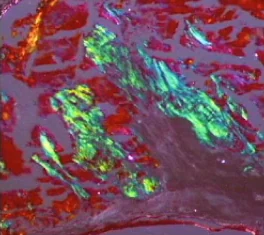
A 51-year-old woman comes to the clinic for a routine health maintenance examination. On physical examination, a thyroid nodule is palpated. Serum TSH is 2.4 mIU/L (NR 0.5-5.0). Ultrasound-guided biopsy of the mass is performed and shown. Serum calcium is 9.4 mg/dL (NR 8.4-10.2). Which of the following is most likely to be seen in this patient?
Show answer and explanation
Correct answer: A. Decreased osteoclast activity
The answer
The key finding is the biopsy. It shows apple-green birefringence with Congo red stain, the classic picture of amyloid. In a thyroid nodule, that points to medullary thyroid carcinoma. Notice that the TSH and calcium are both normal.
In medullary thyroid carcinoma, serum calcitonin is increased. The parafollicular C cells of the thyroid make calcitonin, and calcitonin works by inhibiting osteoclasts. So the finding to expect is decreased osteoclast activity, which is option A. Her calcium is still normal, because calcitonin has only a small effect on blood calcium in humans.
Why B, C, D and E are wrong
B, decreased serum phosphate, and C, increased bone turnover, would fit primary hyperparathyroidism, but her serum calcium is normal. D, psammoma bodies, are seen in papillary thyroid carcinoma, not medullary. E, uric acid urolithiasis, does not fit either: her calcium is normal, and uric acid stones are linked to low urine pH, gout and chronic diarrhea.
High-yield tips
★ High-yield tip #1
C-cell hyperplasia
NBME questions may even describe parafollicular C-cell hyperplasia on the biopsy. That points to medullary thyroid carcinoma too, because the parafollicular C cells of the thyroid are the cells that make calcitonin.
★ High-yield tip #2
Amyloid and Congo red
Apple-green birefringence with Congo red under polarized light means amyloid, which is misfolded protein deposited in tissue. You can see the same staining elsewhere, such as in renal and cardiac amyloidosis linked to multiple myeloma. In principle, any amyloid can give apple-green birefringence.
★ High-yield tip #3
Calcitonin is not the opposite of PTH
Students often think calcitonin is simply the opposite of PTH. It isn’t. PTH acts on osteoblasts, which express RANKL. RANKL binds the RANK receptor on osteoclasts and drives bone resorption, so calcium leaches out of bone into the blood and serum calcium rises.
★ High-yield tip #4
What calcitonin does
Calcitonin is not a reverse PTH. It acts directly on osteoclasts and inhibits them, so less calcium is released from bone. In humans, its effect on blood calcium is small. That is why patients with medullary carcinoma usually have normal calcium even when calcitonin is very high. The osteoclast effect is what the USMLE really wants you to know.
★ High-yield tip #5
Bisphosphonates
The exam also wants you to know that bisphosphonates, such as alendronate and pamidronate, inhibit osteoclasts too, as drugs. For osteoporosis, weight-bearing exercise matters, and brisk walking beats swimming for bone density. Adequate calcium and vitamin D are also part of care. For drug therapy, a bisphosphonate such as alendronate is the usual first-choice drug.
★ High-yield tip #6
Other bisphosphonate uses
Pamidronate is used for hypercalcemia of malignancy, along with vigorous saline hydration. In family medicine especially, bisphosphonates are also given to patients on long-term corticosteroids to prevent osteoporosis.
★ High-yield tip #7
MEN 2A and urinary stones
Urolithiasis means urinary stones that have moved out of the kidney into the rest of the urinary tract, such as the ureter. Medullary thyroid carcinoma can be part of MEN 2A, along with hyperparathyroidism from a parathyroid adenoma or hyperplasia, which can cause kidney stones. Uric acid stones, by contrast, are linked to low urine pH, gout and chronic diarrhea.
★ High-yield tip #8
Psammoma bodies
Students get anxious about psammoma bodies as if they were high-yield. They do show up on NBME exams, but they aren’t high-yield. Psammoma bodies are laminated, ring-like calcium deposits seen in papillary thyroid carcinoma, mesothelioma, meningioma, and serous cystadenocarcinoma of the ovary.
★ High-yield tip #9
Hyperparathyroidism and Paget disease
Increased bone turnover could fit hyperparathyroidism, where excess PTH drives osteoclastic bone resorption, and a raised calcium from primary hyperparathyroidism could go with a decreased serum phosphate. Bone turnover is also a very generic answer choice. As a side note, Paget disease of bone has mixed osteoclastic and osteoblastic activity with an isolated rise in serum alkaline phosphatase, and exams like this descriptor for it.
Sources: StatPearls: Medullary Thyroid Cancer; StatPearls: Calcitonin; StatPearls: Physiology, Bone Remodeling; StatPearls: Cardiac Amyloidosis; ATA Revised Guidelines for Medullary Thyroid Carcinoma (2015); MedlinePlus: TSH Test; GeneReviews: Multiple Endocrine Neoplasia Type 2; StatPearls: Histology, Thyroid Gland; Endotext: Calcium and Phosphate Homeostasis; StatPearls: Urolithiasis; StatPearls: Primary Hyperparathyroidism; StatPearls: Papillary Thyroid Carcinoma; StatPearls: Meningioma; StatPearls: Malignant Mesothelioma; StatPearls: Epithelial Ovarian Cancer; StatPearls: Paget Bone Disease; StatPearls: Physiology, Parathyroid Hormone; StatPearls: Multiple Myeloma; Prolia (denosumab) prescribing information; Fosamax (alendronate) prescribing information; Pamidronate disodium injection prescribing information; ACP Guideline: Bisphosphonates for Initial Treatment of Osteoporosis (2023); MedlinePlus: Exercise, Lifestyle, and Your Bones; Actonel (risedronate) prescribing information; MedlinePlus: Osteoporosis
Question 6
A 33-year-old man comes to the clinic for a 2-day history of neck pain and palpitations. Three weeks ago, he recovered from a viral upper respiratory tract infection. Heart rate is 95. Which of the following is most likely to be seen in this patient?
Show answer and explanation
Correct answer: A. Decreased I131 uptake
The answer
The clues are neck pain and palpitations three weeks after a viral upper respiratory infection. Neck pain after a viral infection points to a painful thyroid, which is de Quervain thyroiditis, also called subacute granulomatous thyroiditis. The palpitations and a heart rate of 95 fit its hyperthyroid phase.
In de Quervain, the thyroid gland isn’t taking up iodine to make new hormone. Instead, inflammation damages the thyroid follicles, so hormone that was already stored leaks out into the blood. That’s why the patient is hyperthyroid, but because no new hormone is being made, uptake is low.
Why B, C, D and E are wrong
B, diffusely increased uptake, is Graves disease. C is wrong because overt hyperthyroidism puts free T4 above the normal range. D is wrong because in primary hyperthyroidism TSH is suppressed, not increased. E, microsomal antibodies, point to Hashimoto thyroiditis, which causes hypothyroidism, and this patient clearly doesn’t have hypothyroidism.
High-yield tips
★ High-yield tip #1
The names of de Quervain thyroiditis
De Quervain thyroiditis is also called subacute granulomatous thyroiditis, or simply subacute thyroiditis. The exam may write just subacute thyroiditis as the answer, and that confuses students who don’t know it by that name.
★ High-yield tip #2
The classic picture
The textbook story is a viral infection, followed weeks later by a painful, tender thyroid gland. But the exam doesn’t have to mention the viral infection. If a question leaves it out, it’s still de Quervain, because the thyroid gland is tender and painful.
★ High-yield tip #3
Uptake is low even when hyper
What you need to know is that uptake is low, even when the patient is hyperthyroid. That’s why the exam likes to show de Quervain in the hyperthyroid phase. If they gave it to you in the hypothyroid phase, choosing decreased uptake would be too easy. They want to see that you know uptake is low even when the patient is hyper.
★ High-yield tip #4
Graves disease
Diffusely increased I131 uptake refers to Graves disease. In Graves, you get high T3 and T4, suppressed TSH, and diffusely increased uptake. The mechanism is thyroid-stimulating immunoglobulin, an activating antibody against the TSH receptor. That makes Graves a type II hypersensitivity reaction.
★ High-yield tip #5
Hyperthyroidism with a nodule
On Step 2 CK, if a patient has hyperthyroidism and a thyroid nodule, get an iodine uptake scan. Uptake in a single nodule means toxic adenoma. Diffuse uptake, even if you feel a nodule, means Graves disease. Uptake in multiple nodules means toxic multinodular goiter.
★ High-yield tip #6
Overt versus subclinical disease
When a patient has overt hypo- or hyperthyroidism, free T4 is out of the normal range. In subclinical disease, TSH is abnormal but free T4 stays normal, and symptoms are often mild or nonspecific.
★ High-yield tip #7
Which thyroid test
For Step 2 CK, the best initial test of thyroid function is TSH, keeping in mind that its normal range is different in pregnancy. Free T4, checked along with TSH, then more accurately reflects how the gland is functioning, which is why it confirms whether the patient is truly hypo- or hyperthyroid.
★ High-yield tip #8
TSH in primary and secondary disease
In primary hyperthyroidism, where the problem is in the thyroid gland itself, the extra thyroid hormone feeds back on the pituitary, so TSH is suppressed. TSH can be high in secondary hyperthyroidism, for example from a TSH-secreting tumor of the anterior pituitary. On the flip side, one offline NBME question gives decreased TSH with decreased T4, and the answer is secondary hypothyroidism, such as Sheehan syndrome.
★ High-yield tip #9
Hashimoto thyroiditis
Microsomal antibodies, also called anti-thyroid peroxidase antibodies, point to Hashimoto thyroiditis, where you can also see anti-thyroglobulin antibodies. Hashimoto has a lymphocytic infiltrate in the thyroid gland, so it’s also called chronic lymphocytic thyroiditis. Expect a decreased T4 and an increased TSH, while T3 is often still normal. That’s textbook hypothyroidism.
Sources: StatPearls: De Quervain Thyroiditis; StatPearls: Thyrotoxicosis; StatPearls: I-123 Uptake; StatPearls: Graves Disease; StatPearls: Type II Hypersensitivity Reaction; StatPearls: Hypothyroidism; ATA: Thyroid Function Tests; StatPearls: Physiology, Thyroid Hormone; MedlinePlus: Antithyroid Peroxidase Antibody; StatPearls: Hashimoto Thyroiditis; MedlinePlus: TSH Test
Question 7
A 34-year-old woman comes to the clinic with a 3-day history of palpitations and neck tenderness. She recently recovered from a viral upper respiratory tract infection. Serum TSH is 0.01 mIU/L. Which of the following is most likely to be seen in this patient?
Show answer and explanation
Correct answer: D. Reduced 131I uptake
The answer
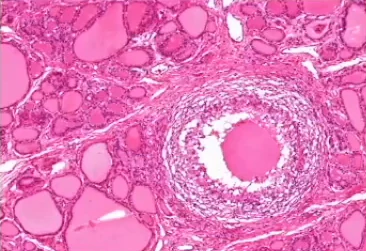
What you need to know straight away is that the diagnosis is subacute granulomatous thyroiditis, also called subacute thyroiditis or de Quervain thyroiditis, because the thyroid is tender. A tender or painful thyroid is de Quervain until proven otherwise. Since it’s granulomatous, you can infer the image probably shows a granuloma.
You don’t need to read the image or know the exact TSH range: 0.01 is clearly low, since normal is roughly 0.4 to 5, so the TSH is suppressed. In de Quervain, iodine uptake is low even when the patient is hyperthyroid like this. The inflamed gland is leaking stored thyroid hormone into the blood, not making new hormone. That is option D, reduced 131I uptake.
Why A, B, C and E are wrong
A, anti-microsomal antibody, is the anti-thyroid peroxidase antibody of Hashimoto thyroiditis. B, a hot nodule, is a toxic adenoma that secretes hormone on its own. C, exophthalmos, points to Graves disease. E, thyroid-stimulating immunoglobulin, is the antibody that causes Graves disease.
High-yield tips
★ High-yield tip #1
De Quervain across the spectrum
In de Quervain, or subacute granulomatous thyroiditis, uptake is low, even if the patient is hyperthyroid. It can present across the spectrum: hypo, eu or hyperthyroid. The exam tends to give it to you hyperthyroid, to check that you know iodine uptake is decreased in thyroiditis. In the hypothyroid phase, choosing decreased uptake would be obvious.
★ High-yield tip #2
Why uptake is low
Uptake is low because the gland isn’t making new thyroid hormone, unlike Graves, toxic adenoma or toxic multinodular goiter, where uptake is increased. In de Quervain, inflammation damages the gland, so stored thyroid hormone leaks out into the blood. With TSH suppressed, new hormone production is actually turned down.
★ High-yield tip #3
The viral clue
De Quervain often follows a viral infection, but in truth only about a third of questions will tell you that. The exam does this in general. It doesn’t have to mention a viral infection before low platelets in ITP, or before transient synovitis, which is a painful hip in children. Also, the exam can give you de Quervain as hypo- or hyperthyroid.
★ High-yield tip #4
Hashimoto thyroiditis
Anti-microsomal antibody, also known as anti-thyroid peroxidase, is for Hashimoto thyroiditis. You can also see anti-thyroglobulin antibodies. Hashimoto is the classic primary hypothyroidism, with autoimmune destruction of the thyroid gland. T4 is low, and TSH goes up to compensate, while T3 is often still normal.
★ High-yield tip #5
Hot nodules
A hot nodule is a thyroid adenoma that secretes hormone on its own, also called a toxic adenoma. This is more Step 2 CK level, across family medicine, internal medicine and surgery. The exam loves to test whether you know how to evaluate cold versus hot nodules.
★ High-yield tip #6
Working up a thyroid nodule
If you’re evaluating for thyroid cancer and both are listed, the first step is palpating the thyroid gland, not TSH. If a nodule is palpated, the next best step is TSH. A high or normal TSH, meaning the patient is hypo- or euthyroid, keeps malignancy on the table, because a higher TSH is linked to a higher cancer risk, and hyperfunctioning, or hot, nodules rarely harbor malignancy.
★ High-yield tip #7
Cold versus hot nodules
For a nodule with high or normal TSH, do an ultrasound followed by fine needle aspiration. If ultrasound is listed, choose it. If it isn’t, choose FNA. If TSH is suppressed, the nodule may be hot, meaning a toxic adenoma, and the next best step is a radioactive iodine uptake scan. A hot nodule rarely harbors malignancy.
★ High-yield tip #8
Graves disease
Exophthalmos, or proptosis, is a protrusion of the eyes, and it points to Graves disease. Graves is autoimmunity of the thyroid gland driven by thyroid-stimulating immunoglobulin. TSI binds to and activates the TSH receptor, a type II hypersensitivity reaction. You get increased T3 and T4 with a suppressed TSH.
★ High-yield tip #9
Graves-specific findings
Exophthalmos and pretibial myxedema are classic extrathyroidal signs of Graves disease, and de Quervain lacks them. Many Graves patients don’t have eye findings, but if a vignette describes hyperthyroidism and goes out of its way to say there’s no exophthalmos, the exam is steering you away from Graves.
Sources: StatPearls: De Quervain Thyroiditis; StatPearls: Thyrotoxicosis; StatPearls: I-123 Uptake; StatPearls: Physiology, Thyroid Hormone; MedlinePlus: TSH Test; MedlinePlus: Antithyroid Peroxidase Antibody; StatPearls: Hashimoto Thyroiditis; StatPearls: Hypothyroidism; ATA: Thyroid Function Tests; 2015 ATA Guidelines: Thyroid Nodules and Differentiated Thyroid Cancer; MedlinePlus: Eyes, Bulging; StatPearls: Graves Disease; StatPearls: Type II Hypersensitivity Reaction; StatPearls: Immune Thrombocytopenia; StatPearls: Transient Synovitis; StatPearls: Graves Orbitopathy
Question 8
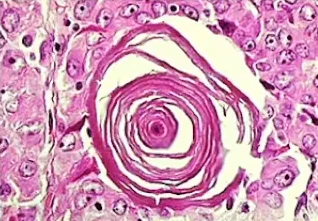
A 45-year-old woman returns to the clinic for follow-up after a recent cancer diagnosis. A biopsy specimen is shown. Which of the following is most likely to be seen in this patient?
Show answer and explanation
Correct answer: D. Normal serum thyroid-stimulating hormone
The answer
The clue is the biopsy, which shows a psammoma body, a ring-like, layered accumulation of calcium seen in some cancers. In a question like this one, the cancer to think of is papillary thyroid carcinoma.
With thyroid cancers such as papillary carcinoma, most patients have normal thyroid function, so TSH is usually normal. The point is, they’re not hyperthyroid. Papillary cancers typically appear as cold nodules, meaning hypofunctioning nodules that don’t make extra hormone, while hyperfunctioning nodules are rarely malignant.
Why A, B, C and E are wrong
A, decreased parathyroid hormone, has nothing to do with this picture; think of it after thyroidectomy or in DiGeorge syndrome. B, elevated calcitonin, is medullary thyroid carcinoma, not papillary thyroid carcinoma. C, a RET mutation, is for MEN2 and medullary thyroid cancer. E, signet ring cells, contain mucin and are classic for gastric cancer.
High-yield tips
★ High-yield tip #1
Psammoma bodies
A psammoma body is a ring-like, layered accumulation of calcium seen in some cancers. They’re not extremely high yield, but students report seeing them on the real exam. You can see them in papillary thyroid carcinoma, serous cystadenocarcinoma of the ovary, mesothelioma and meningioma.
★ High-yield tip #2
Hot nodules
If a patient has a nodule and is hyperthyroid, TSH is suppressed. In a way, that’s good news, because it means the nodule is very unlikely to be malignant. A hot nodule is known as a toxic adenoma.
★ High-yield tip #3
Thyroid nodule workup
This is more Step 2 CK, but quickly: if a patient has a thyroid nodule, measure serum TSH next. If it’s normal or elevated, the next best step is ultrasound if it’s listed. If ultrasound isn’t listed, choose fine needle aspiration. If TSH is decreased, the next best step is a radionuclide uptake scan, preferably with 123I.
★ High-yield tip #4
Hypoparathyroidism after thyroidectomy
For primary hypoparathyroidism, know two high-yield points. Number one, it can happen after thyroidectomy, because the parathyroids can be removed along with the thyroid. Then calcium and PTH are both low.
★ High-yield tip #5
Signs of hypocalcemia
After thyroid surgery, look for signs of low calcium. Chvostek sign is twitching of the facial muscles when you tap the facial nerve in front of the ear. Trousseau sign is carpal spasm when a blood pressure cuff is inflated on the arm. Both point to hypocalcemia.
★ High-yield tip #6
DiGeorge syndrome
The other important point is DiGeorge syndrome, where the third and fourth pharyngeal pouches fail to develop. The third pouches give the two inferior parathyroids and the thymus. The fourth pouches give the superior parathyroids. So again, PTH is low and calcium is low.
★ High-yield tip #7
Calcitonin
Calcitonin is increased in medullary thyroid carcinoma, not papillary thyroid carcinoma. You can also get C-cell hyperplasia, which has appeared on an NBME question. Know the mechanism: calcitonin inhibits osteoclast activity. Bisphosphonates such as alendronate also inhibit osteoclasts, so think of them as the outside drug that does what calcitonin does inside the body.
★ High-yield tip #8
Medullary thyroid carcinoma and MEN2
Medullary thyroid carcinoma shows amyloid on biopsy, with apple-green birefringence on Congo red stain. It can also be part of MEN2, both 2A and 2B. Both come from the RET proto-oncogene and include pheochromocytoma and medullary thyroid cancer. MEN2A adds parathyroid adenoma or diffuse four-gland hyperplasia. MEN2B adds mucosal neuromas and a marfanoid body habitus.
★ High-yield tip #9
RET on the exam
As just mentioned, RET is for MEN2, both 2A and 2B. A bonus point: when MEN2 shows up on the exam, they don’t need to give you the whole constellation, because real patients don’t develop every finding at once. An NBME question can simply say the patient has medullary thyroid cancer and ask which gene is mutated. The answer is RET.
★ High-yield tip #10
Signet ring cells
Signet ring cells contain mucin and are classic for gastric cancer, which can give a leather-bottle appearance of the stomach called linitis plastica. Gastric cancer can spread to both ovaries, and those metastases are called Krukenberg tumors.
Sources: StatPearls: Papillary Thyroid Carcinoma; 2015 ATA Guidelines: Thyroid Nodules and Differentiated Thyroid Cancer; StatPearls: Histology, Thyroid Gland; StatPearls: Meningioma; StatPearls: Epithelial Ovarian Cancer; StatPearls: Malignant Mesothelioma; StatPearls: Hypoparathyroidism; StatPearls: Hypocalcemia; StatPearls: DiGeorge Syndrome; StatPearls: Embryology, Parathyroid; StatPearls: Medullary Thyroid Cancer; StatPearls: Calcitonin; StatPearls: Bisphosphonate; StatPearls: Multiple Endocrine Neoplasia Type 2; StatPearls: Gastric Cancer; StatPearls: Krukenberg Tumor; StatPearls: Hyperthyroidism; StatPearls: Thyrotoxicosis; StatPearls: Thyroid Cancer; StatPearls: Trousseau Sign
Question 9
A 39-year-old woman comes to her primary care physician because of a 6-month history of irregular menses and increasing fatigue. She says her mood has been low and she has recently lost interest in social activities. Vitals are: temperature 98.2F, HR 55, RR 14, BP 118/76. BMI is 26. Serum total cholesterol is 300 mg/dL. Hepatic AST is 70 IU/L (NR 10-40). Creatine kinase is 200 U/L (NR 30-180). She is started on exogenous triiodothyronine. Which of the following combinations of serum findings is most likely to be seen following administration?
Show answer and explanation
Correct answer: D. ↑ T3; ↓ T4; ↓ TSH
The answer
The vignette describes hypothyroidism, most likely Hashimoto thyroiditis, and the question hands it to you by saying she is given thyroid hormone. Her clues are irregular menses, low mood, a heart rate of 55, a BMI of 26, which is only overweight, a total cholesterol of 300, when it should be under 200, a raised AST and a raised creatine kinase. All of these fit hypothyroidism.
She is given exogenous T3, so serum T3 goes up. That extra T3 causes negative feedback on the hypothalamus and the pituitary, which shuts off TRH and TSH. So T3 is increased and TSH is decreased.
Low TSH shuts off the thyroid’s own hormone production. Losing our own T3 doesn’t matter, because we are giving it. But T4 is the thyroid’s main product, and our own T4 production stops too, so serum T4 falls. That gives ↑ T3, ↓ T4 and ↓ TSH, which is option D.
Why the other options are wrong
E, F, G and H all show a decreased T3, but giving T3 raises it. A and C show an increased TSH, but the extra T3 suppresses it. B, with T4 increased too, would fit exogenous levothyroxine, which is T4, not T3.
High-yield tips
★ High-yield tip #1
Where students slip
This is where students slip: with exogenous T3, T4 is decreased, not increased. Memorize this: T4 is the thyroid’s main product, and it is converted to T3 in the tissues. The FDA label even notes that serum T4 can’t be used to monitor liothyronine.
★ High-yield tip #2
Exogenous levothyroxine
Choice B would be correct if we gave exogenous levothyroxine, which is T4. T4 would go up, and it would be converted to T3 in the periphery, so T3 would also be high. That would cause negative feedback, so TSH would be low.
★ High-yield tip #3
The two patterns to remember
So the two patterns to remember: exogenous T3 gives you ↑ T3, ↓ T4 and ↓ TSH. Exogenous T4, or levothyroxine, gives you ↑ T3, ↑ T4 and ↓ TSH.
★ High-yield tip #4
Subtle hypothyroid findings
Irregular menses are extremely important in hypothyroidism, and low mood, dysthymia or depression can be seen too. A heart rate of 55 to 60 can be normal in a healthy person, but NBME exams like to use it, and it can support hypothyroidism when you are not sure. The patient does not have to be obese; an overweight BMI can still fit.
★ High-yield tip #5
Hypothyroid lab clues
Hypothyroidism can raise total cholesterol, which should be under 200. A raised AST can look strange, but thyroid dysfunction can cause transaminitis, with a raised AST, ALT, or both. And creatine kinase can rise from hypothyroid myopathy, even when the question never mentions proximal muscle weakness or pain.
★ High-yield tip #6
Hypothyroid clues recap
Beyond the buzzy findings like constipation, brittle hair, dry skin and cold intolerance, know these hypothyroid clues: menstrual irregularities, dysthymia or depression, apathy, bradycardia, increased total cholesterol, transaminitis, and hypothyroid myopathy with an increased CK.
Sources: Cytomel (liothyronine sodium) prescribing information; StatPearls: Physiology, Thyroid Hormone; Endotext: Physiology of the Hypothalamic-Pituitary-Thyroid Axis; Hypothyroidism (Underactive Thyroid); MedlinePlus: Hypothyroidism; StatPearls: Hypothyroidism; StatPearls: Hashimoto Thyroiditis; MedlinePlus: Pulse; Adult BMI Categories; MedlinePlus: Cholesterol Levels: What You Need to Know; StatPearls: Hypothyroid Myopathy; Cytomel (liothyronine sodium) label; StatPearls: Physiology, Thyroid Function; StatPearls: Levothyroxine; StatPearls: Physiology, Thyroid
Question 10
A 42-year-old woman comes to the clinic with her sister because of a 10-month history of weight gain, fatigue, and irregular menses. Vitals are: temperature 98.4F, HR 55, RR 14, BP 116/74. BMI is 25. She gives short, quiet answers during the interview and makes little eye contact. Which of the following additional findings is most likely to be seen in this patient?
Show answer and explanation
Correct answer: E. Lymphocytic infiltration
The answer
Her clues are fatigue, weight gain and irregular menses, plus a slow heart rate of 55 and short, quiet answers that suggest low mood. Her BMI of 25 does not argue against it. Together they point to hypothyroidism, and the diagnosis is Hashimoto thyroiditis.
Hashimoto thyroiditis is also called chronic lymphocytic thyroiditis. On biopsy, lymphocytes infiltrate the thyroid gland, so the finding to expect is lymphocytic infiltration, option E. This biopsy finding has been asked on the USMLE.
Why A, B, C and D are wrong
A, apple green birefringence with Congo red stain, means amyloid, and its thyroid link is medullary thyroid carcinoma. B is wrong because hypothyroidism raises serum cholesterol. C is wrong because creatine kinase goes up, from hypothyroid myopathy. D is wrong because transaminases can be raised in hypothyroidism, not lowered.
High-yield tips
★ High-yield tip #1
Menses and BMI in hypothyroidism
A BMI doesn’t have to be high to fit hypothyroidism; 25 is right at the cutoff where overweight begins. Menstrual irregularities are extremely high yield for hypothyroidism on the USMLE, alongside fatigue and weight gain.
★ High-yield tip #2
Why the menses are irregular
The mechanism behind the irregular menses is a little unusual. Low thyroid hormone can raise TRH, and TRH can stimulate prolactin release. Raised prolactin inhibits GnRH release, which can disturb the menstrual cycle. Don’t lean on that mechanism, because it can cost you questions. The main control of prolactin is dopamine, which inhibits its release. Questions are far more likely to describe a cut pituitary stalk, where loss of dopamine inhibition lets prolactin rise.
★ High-yield tip #3
Heart rate and mood
A heart rate of 55 is a sneaky clue USMLE likes to use. A heart rate of 72 doesn’t exclude hypothyroidism, and healthy people can have a rate of 55. But if you already suspect hypothyroidism, a rate of 55 or 60 supports it. Short, quiet answers suggest low mood, and hypothyroidism is a cause of dysthymia and depression.
★ High-yield tip #4
Cholesterol
So questions can give you increased serum cholesterol in hypothyroidism. Vignettes, especially at the Step 2 CK level, may simply say the total cholesterol is 300. Just know that dyslipidemia can be seen with hypothyroidism.
★ High-yield tip #5
Creatine kinase
In hypothyroidism, creatine kinase goes up, not down, because of hypothyroid myopathy. There can be proximal muscle weakness or pain, with breakdown of some skeletal muscle that raises serum CK.
★ High-yield tip #6
Transaminases
The USMLE can give you an elevated ALT, AST, or both in hypothyroidism. On NBME exams, you may see a hypothyroid vignette with only the AST elevated and nothing said about the ALT. It seems odd, but thyroid dysfunction can cause transaminitis.
★ High-yield tip #7
Amyloid and the thyroid
Apple green birefringence with Congo red stain means amyloid, made of beta-pleated sheets. You can find dozens of causes of amyloidosis, but the highest-yield thyroid link for USMLE is medullary thyroid carcinoma. Renal amyloidosis, cardiac amyloidosis, or amyloid with autoimmune disease are not impossible, but none is the most likely answer here.
★ High-yield tip #8
Hypothyroid recap
Look beyond cold intolerance, constipation, weight gain, brittle hair and dry skin, which are often left out because they are too easy. Know menstrual irregularities, increased CK from hypothyroid myopathy, hypercholesterolemia, transaminitis, dysthymia or depression, and bradycardia.
Sources: StatPearls: Hashimoto Thyroiditis; Hashimoto’s Disease; StatPearls: Hypothyroidism; Hypothyroidism (Underactive Thyroid); Adult BMI Categories; MedlinePlus: Pulse; StatPearls: Amyloidosis; StatPearls: Multiple Endocrine Neoplasia Type 2; StatPearls: Hypothyroid Myopathy; MedlinePlus: Hypothyroidism; StatPearls: Hyperprolactinemia; StatPearls: Galactorrhea; MedlinePlus: Cholesterol Levels: What You Need to Know
Question 11
A 37-year-old woman comes to the clinic because of a 3-month history of tremulousness and restlessness. Heart rate is 90. She does not smoke or drink alcohol. Her sister has systemic lupus erythematosus. Which of the following antibodies is most likely to be seen in this patient?
Show answer and explanation
Correct answer: D. Anti-thyrotropin receptor
The answer
This patient has Graves’ disease, a pass-level diagnosis that students still get wrong. Her tremulousness and restlessness fit an overactive thyroid. So why mention her sister’s lupus? Autoimmune diseases go together, so lupus in the family tells you autoimmunity is in play, which points to an autoimmune thyroid disease.
In Graves’ disease, antibodies stimulate the TSH receptor on the thyroid. Thyrotropin is another name for TSH, thyroid stimulating hormone, so the answer is D, anti-thyrotropin receptor. NBME sometimes does this. It isn’t a trick: even if you didn’t know that name, you can get there by elimination. A and C are Hashimoto, and B is primary biliary cholangitis.
Why A, B, C and E are wrong
A, anti-microsomal, and C, anti-thyroperoxidase, are the same antibody, and both point to Hashimoto thyroiditis, which causes hypothyroidism. B, anti-mitochondrial, is for primary biliary cholangitis. E, an antibody against the T3 receptor, is one you have probably never heard of; in theory it would blunt thyroid hormone action, more like hypothyroidism.
High-yield tips
★ High-yield tip #1
Autoimmune diseases go together
Autoimmune diseases go together. You don’t need to memorize strict HLA associations. The vignette can tell you that the patient or a family member has another autoimmune disease, such as vitiligo, rheumatoid arthritis or lupus. The implication is simply that autoimmunity is in play.
★ High-yield tip #2
Another example: pernicious anemia
To reinforce the point with another example: a question may say a patient has vitamin B12 deficiency and also has vitiligo. The implication is that the B12 deficiency is due to pernicious anemia, because autoimmune diseases go together.
★ High-yield tip #3
Treating Graves’ disease
Graves’ disease is treated with thionamides, such as propylthiouracil and methimazole. Both inhibit thyroid peroxidase. PTU also blocks the peripheral conversion of T4 to T3. Both can cause agranulocytosis, a severe form of neutropenia.
★ High-yield tip #4
Thyroid storm
In thyroid storm, PTU is classically chosen over methimazole because it also blocks peripheral T4 to T3 conversion. Steroids are given too; they also lower T4 to T3 conversion, and steroids are used for the eye disease, the proptosis or exophthalmos. Potassium iodide, given after the thionamide, blocks thyroid hormone release, and propranolol treats the tachycardia and also blocks T4 to T3 conversion.
★ High-yield tip #5
Hashimoto thyroiditis
Anti-microsomal antibodies point to Hashimoto thyroiditis. Hashimoto causes hypothyroidism, not hyperthyroidism, so you’d see ↓ T4 with ↑ TSH. On histology, USMLE wants you to know there is a lymphocytic infiltrate within the thyroid gland.
★ High-yield tip #6
Hashimoto findings beyond the buzzwords
Beyond the buzzy findings, cold intolerance, constipation, dry skin and brittle hair, know the others: menstrual irregularities, dysthymia or depression, transaminitis with an increased ALT, AST or both, and hypothyroid myopathy with an increased creatine kinase. These are very important findings.
★ High-yield tip #7
Primary biliary cholangitis
Anti-mitochondrial antibodies are for PBC, primary biliary cholangitis, formerly called primary biliary cirrhosis. Picture a middle-aged woman with generalized itching, high cholesterol, increased alkaline phosphatase, and jaundice with a rising bilirubin as the disease advances. The vignette may say a family member has an autoimmune disease, because autoimmune diseases go together.
★ High-yield tip #8
A gallstone in a PBC question
The question may also show a stone in the gallbladder. That confuses students, who start weighing other biliary diagnoses, such as cholelithiasis, against PBC. Gallstones are very common and often silent, so a stone can simply be an incidental finding. Ursodiol, or ursodeoxycholic acid, is a treatment for PBC.
★ High-yield tip #9
The three Hashimoto antibody names
Anti-thyroperoxidase is the same thing as anti-microsomal, and both are for Hashimoto. Anti-TPO, also called anti-microsomal, and anti-thyroglobulin: these are the three antibody names you need to know for Hashimoto thyroiditis.
Sources: StatPearls: Graves Disease; StatPearls: Thyrotoxicosis; MedlinePlus: TSH (Thyroid-Stimulating Hormone) Test; Graves’ Disease; MedlinePlus: Autoimmune Diseases; Endotext: Hashimoto’s Thyroiditis; StatPearls: Primary Biliary Cholangitis; StatPearls: Hashimoto Thyroiditis; StatPearls: Hypothyroidism; Definition & Facts for Primary Biliary Cholangitis; Diagnosis of Primary Biliary Cholangitis; Symptoms & Causes of Primary Biliary Cholangitis; Cytomel (liothyronine sodium) label; MedGen: Thyroid hormone resistance, generalized; Hashimoto’s Disease; StatPearls: Pernicious Anemia; StatPearls: Methimazole; StatPearls: Propylthiouracil (PTU); StatPearls: Agranulocytosis; StatPearls: Thyroid Storm; MedlinePlus: Bulging Eyes; MedlinePlus: Hypothyroidism; StatPearls: Hypothyroid Myopathy; Definition & Facts for Gallstones; Treatment for Primary Biliary Cholangitis
Question 12
A 30-year-old man comes to the emergency department because of a 4-day history of a very tender neck. He recently recovered from a viral upper respiratory tract infection. Physical examination shows a tender thyroid. Vitals are: temperature 99 F, HR 90, RR 14, BP 120/80. Which of the following combinations of findings is most likely to be seen in this patient?
Show answer and explanation
Correct answer: G. ↓ TSH; ↑ T4; ↓ 131Iodine uptake
The answer
The key clue is a very tender thyroid after a recent viral upper respiratory infection. That is de Quervain thyroiditis, also called subacute granulomatous thyroiditis, or simply subacute thyroiditis. With only a 4-day history, he is early in the disease, which is usually the hyperthyroid phase.
Thyroid hormone, T4 and T3, is increased, and that suppresses TSH from above through negative feedback, so TSH is decreased. Iodine uptake is decreased, not increased, even though the patient is hyperthyroid. So the answer is ↓ TSH, ↑ T4, and ↓ uptake.
Why A, B, C, D, E, F and H are wrong
A and C have a high TSH with a high T4, which would need a central cause, like a TSH-secreting pituitary tumor. B and D have a high TSH with a low T4, a hypothyroid pattern, but this patient is in the early hyperthyroid phase. F and H have a low T4, but thyroid hormone is increased here. E has increased uptake, which fits Graves disease, toxic adenoma or toxic multinodular goiter, not thyroiditis.
High-yield tips
★ High-yield tip #1
Know all three names
The diagnosis is de Quervain thyroiditis, also called subacute granulomatous thyroiditis, or simply subacute thyroiditis. Know all three names. A question can give you this same easy one or two line vignette, and the answer is just ‘subacute thyroiditis’. Students get confused because they are looking for de Quervain or subacute granulomatous.
★ High-yield tip #2
TSH in hyperthyroidism
In primary hyperthyroidism, such as thyroiditis, TSH is suppressed. You would only see a high TSH with hyperthyroidism if there were a central cause, like a TSH-secreting tumor of the anterior pituitary, which is rare and essentially never the answer on the USMLE.
★ High-yield tip #3
The triphasic course of thyroiditis
De Quervain thyroiditis, drug-induced thyroiditis, for example from amiodarone or lithium, and postpartum thyroiditis, which is silent or painless thyroiditis occurring after delivery, can all follow a triphasic course: a hyperthyroid phase, then a hypothyroid phase, then recovery.
★ High-yield tip #4
Why exams show the hyperthyroid phase
For de Quervain and postpartum thyroiditis, the USMLE usually gives you the hyperthyroid state. Why? If they gave you de Quervain in the hypothyroid state, low uptake would be the obvious, logical choice even if you didn’t know the physiology. They want to test that you know uptake is low even when the patient is hyperthyroid.
★ High-yield tip #5
Lithium and amiodarone
Drug-induced thyroiditis is the exception to that exam pattern. NBME questions often just say the patient is on lithium or amiodarone and ask which thyroid problem you’d expect, and the answer is hypothyroidism. When they play with the uptake arrows, it tends to be de Quervain, the highest-yield diagnosis here.
★ High-yield tip #6
Recap of low uptake
To recap: choose decreased uptake in the hyperthyroid state not only for de Quervain, but also for drug-induced thyroiditis from amiodarone or lithium, and for silent thyroiditis, including postpartum thyroiditis, even though the patient is hyperthyroid.
★ High-yield tip #7
When uptake is increased
If you chose increased uptake in this hyperthyroid setting, you would pick E: ↓ TSH, ↑ T4, ↑ uptake. It is wrong here, but it would be correct for Graves’ disease, toxic adenoma, and toxic multinodular goiter.
Sources: StatPearls: De Quervain Thyroiditis; StatPearls: Thyrotoxicosis; StatPearls: Physiology, Thyroid Stimulating Hormone; Endotext: Thyrotropin-Secreting Pituitary Adenomas; StatPearls: Physiology, Thyroid Hormone; StatPearls: Thyroiditis; MedlinePlus: Silent thyroiditis; StatPearls: Postpartum Thyroiditis; MedlinePlus: Radioactive iodine uptake; StatPearls: Hyperthyroidism; Cordarone (amiodarone) prescribing information
Question 13
A 37-year-old woman who works as a schoolteacher comes to her primary care clinic because of a 10-month history of gradually progressive fatigue, weight gain, and cold intolerance. Her menses used to be 28 days and regular. For the past 5 months, they have grown increasingly heavy and unpredictable. She also reports mild constipation and recent difficulty concentrating. Physical examination shows dry skin and a mildly enlarged, firm thyroid gland. Laboratory studies show an increased TSH and low free T4. Anti-microsomal antibodies are positive. A fine-needle aspiration biopsy is performed to confirm the diagnosis. Which of the following histologic findings is most consistent with this patient’s diagnosis?
Show answer and explanation
Correct answer: D. Lymphocytic infiltration with germinal center formation
The answer
This question hands you the diagnosis: Hashimoto thyroiditis. The clue is the positive anti-microsomal antibodies, which are the same as anti-thyroid peroxidase antibodies. Her weight gain, cold intolerance and constipation fit hypothyroidism, along with the high TSH, the low free T4 and the firm, enlarged thyroid.
Another name for Hashimoto thyroiditis is chronic lymphocytic thyroiditis. If you know that, the question is easy: the biopsy shows lymphocytic infiltration with germinal center formation, which is option D.
Why A, B, C and E are wrong
A, multinucleated giant cells and disrupted follicles, points to de Quervain thyroiditis. B, amyloid derived from calcitonin, is medullary thyroid carcinoma. C, branching papillae with nuclear grooves, is papillary thyroid carcinoma. E, scalloped colloid in hyperplastic follicles, is Graves disease, and a hypothyroid gland would not have hyperplastic follicles.
High-yield tips
★ High-yield tip #1
Hashimoto antibodies and the gut
Besides anti-microsomal, or anti-thyroid peroxidase, antibodies, you can also see anti-thyroglobulin antibodies in Hashimoto thyroiditis. Thyroid dysfunction also affects the gut: hypothyroidism causes constipation, and hyperthyroidism causes diarrhea.
★ High-yield tip #2
Menstrual changes
Abnormal menses can occur with both hypothyroidism and hyperthyroidism. In hypothyroidism, free T4 is low, so the hypothalamus raises TRH to compensate. TRH also stimulates prolactin. When prolactin goes up, it inhibits GnRH release, and that can cause abnormal menses.
★ High-yield tip #3
Biopsy questions
When a question asks what a biopsy will show, you don’t have to be a histopathologist to answer it. You just have to know the diagnoses well, and then infer the answer.
★ High-yield tip #4
The Step exams overlap
On histology questions you can often eliminate your way to the answer, but knowing that Hashimoto is also called chronic lymphocytic thyroiditis is the shortcut. It sounds like a Step 1 fact, but a Step 2 CK form asked exactly this, and the answer was lymphocytic infiltration. The Step exams overlap a lot.
★ High-yield tip #5
Germinal centers
Germinal centers form inside lymphoid follicles. There, B cells activated by antigen, with help from T cells, proliferate and become plasma cells or memory B cells. Lymphocytic infiltration with germinal center formation is what you see in Hashimoto thyroiditis.
★ High-yield tip #6
Granulomas in de Quervain
Multinucleated giant cells and disrupted follicles point to de Quervain thyroiditis, also called subacute granulomatous thyroiditis. Granulomas are collections of activated macrophages, also called epithelioid macrophages or histiocytes. These macrophages fuse and become multinucleated. As an aside, sarcoidosis gives non-caseating granulomas in the lungs, built from the same epithelioid macrophages.
★ High-yield tip #7
When de Quervain is the answer
De Quervain thyroiditis is the answer when the thyroid is painful or tender. Only about half the time will the question tell you that a viral infection came first. The same is true for ITP: the exam mentions the preceding viral infection only about half the time.
★ High-yield tip #8
De Quervain uptake
Know that radioiodine uptake is low in de Quervain thyroiditis, even if the patient is hyperthyroid. It can present as hypothyroid or hyperthyroid. In the hyperthyroid version, uptake is still low, not increased, because the gland isn’t making more hormone. Inflammation simply lets stored thyroid hormone leak into the blood.
★ High-yield tip #9
Medullary thyroid carcinoma
Amyloid derived from calcitonin is the buzzword for medullary thyroid carcinoma. It’s the highest-yield thyroid cancer on USMLE because there’s so much to ask about. The amyloid shows apple-green birefringence with Congo red stain, and the tumor is associated with the RET gene.
★ High-yield tip #10
Familial medullary cancer
RET doesn’t require all the features of MEN2A or MEN2B. A family can have medullary thyroid cancer alone. Say a 20-year-old man has medullary thyroid cancer, and his brother and father had it too. The answer is RET. You may think other findings are needed, but medullary thyroid cancer alone is enough.
★ High-yield tip #11
Calcitonin
Calcitonin is classically increased in medullary thyroid carcinoma. Know its mechanism: calcitonin inhibits osteoclast activity, and they will ask that. Bisphosphonates, given as drugs, have the same end effect. They also inhibit osteoclasts.
★ High-yield tip #12
Papillary thyroid carcinoma
Branching papillae with nuclear grooves and inclusions describe papillary thyroid carcinoma. Besides the papillary structure, it has psammoma bodies, which are whorled, round calcifications. Psammoma bodies show up in papillary thyroid carcinoma, serous cystadenocarcinoma of the ovary, meningioma and mesothelioma. Orphan Annie eye nuclei are also seen, but they are lower yield.
★ High-yield tip #13
Reasoning out Graves disease
Say you still weren’t sure, and scalloped colloid means nothing to you. Hyperplastic follicles point to Graves disease. In Hashimoto, a hypothyroid condition, would the follicles be hyperplastic? That doesn’t make sense, since these follicular cells are not overproducing thyroid hormone. In Graves disease, by contrast, you have increased T3 and T4 and a suppressed TSH. Look for proptosis, also called exophthalmos, and pretibial myxedema.
Sources: Endotext: Hashimoto’s Thyroiditis; StatPearls: Hashimoto Thyroiditis; StatPearls: Hypothyroidism; StatPearls: Hyperthyroidism; StatPearls: Histology, B-Cell Lymphocyte; StatPearls: De Quervain Thyroiditis; StatPearls: Granuloma; StatPearls: Sarcoidosis; StatPearls: Multiple Endocrine Neoplasia Type 2; StatPearls: Medullary Thyroid Cancer; StatPearls: Papillary Thyroid Carcinoma; StatPearls: Meningioma; StatPearls: Epithelial Ovarian Cancer; StatPearls: Malignant Mesothelioma; StatPearls: Histology, Thyroid Gland; StatPearls: Graves Disease; StatPearls: Exophthalmos; StatPearls: Hyperprolactinemia; StatPearls: Physiology, Thyroid Hormone; StatPearls: Immune Thrombocytopenia; StatPearls: Thyroiditis; Revised ATA Guidelines for the Management of Medullary Thyroid Carcinoma (2015); StatPearls: Calcitonin; StatPearls: Bisphosphonate
Question 14
A 28-year-old woman presents to her primary care physician with a 2-month history of restlessness and feeling periodic “hot flashes,” as though she’s going through menopause. Vitals show a slightly elevated heart rate. Past medical history is unremarkable. She takes no medications. Her sister has SLE. Which of the following is the most likely explanation for this patient’s findings?
Show answer and explanation
Correct answer: E. Autoantibodies against thyrotropin binding site
The answer
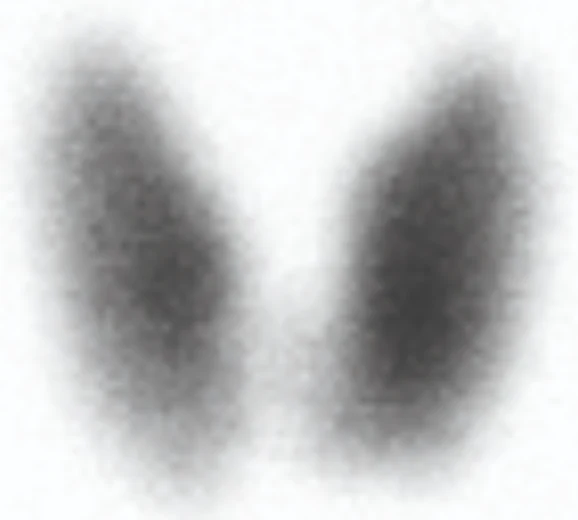
She is hyperthyroid: restlessness, heat intolerance that she describes as menopause-like hot flashes, and a fast heart rate. Her sister’s lupus is a clue, because autoimmune diseases go together. The image is a thyroid uptake scan, and you don’t need to be an endocrinologist: it looks like diffusely increased uptake across the whole gland, which is what we expect in Graves disease.
E looks obscure, but it isn’t. Thyrotropin is another name for TSH, thyroid-stimulating hormone. In Graves disease, antibodies called thyroid-stimulating immunoglobulin, or TSI, target and activate the TSH receptor. T3 and T4 go up, and TSH is suppressed. You can also get here by elimination.
Why A, B, C and D are wrong
A, antibodies against the nuclear Smith antigen, point to SLE, her sister’s disease. B, antibodies against mitochondrial proteins, mean primary biliary cholangitis. C, antibodies against the enzyme targeting tyrosine residues, thyroid peroxidase, and D, antibodies against thyroglobulin, both mean Hashimoto thyroiditis. Hashimoto causes hypothyroidism, and she is hyperthyroid.
High-yield tips
★ High-yield tip #1
Autoimmune diseases cluster
Autoimmune diseases go together: one in the patient or the family raises the risk of others. You don’t need strict HLA associations. Instead of a sister with lupus, the question could have said vitiligo, pernicious anemia, or a sister with celiac disease.
★ High-yield tip #2
Other uptake patterns
A single round area of uptake would fit a toxic adenoma. Multiple spots in an elderly patient would fit toxic multinodular goiter. No uptake at all could mean exogenous thyroid hormone. And it’s not de Quervain thyroiditis, which has a tender or painful gland and decreased uptake, even when the patient is hyperthyroid.
★ High-yield tip #3
Graves findings
Graves can cause diarrhea and menstrual irregularities, and you can still get muscle weakness. But the two findings specific to Graves disease that USMLE wants you to know are pretibial myxedema and proptosis, also called exophthalmos or ophthalmopathy.
★ High-yield tip #4
Treating Graves
For Graves, you give PTU or methimazole, and they want you to know these can cause agranulocytosis. For the ophthalmopathy, give steroids. For the tachycardia, give a beta blocker, propranolol, which also inhibits peripheral conversion of T4 to T3. Potassium iodide can be used in some cases.
★ High-yield tip #5
Anti-Smith and lupus
Anti-Smith antibodies point to SLE. The Smith antigen is a component of the nucleus, and anti-Smith is more specific for lupus than anti-dsDNA. USMLE wants you to know that besides the malar rash, a type III hypersensitivity from immune complex deposition, the blood is commonly affected, for example with thrombocytopenia.
★ High-yield tip #6
Lupus on the USMLE
Musculoskeletal involvement such as arthritis affects about 80 to 90 percent of patients with SLE, and you’ll see it in nearly every USMLE lupus vignette. So if a 34-year-old woman has arthritis and low platelets, and nothing else, that’s an easy diagnosis: SLE. They also like discoid lupus, skin findings, and mouth ulcers.
★ High-yield tip #7
Primary biliary cholangitis
Anti-mitochondrial antibodies mean primary biliary cholangitis, formerly called primary biliary cirrhosis. Expect a woman in her 40s or 50s with high cholesterol, raised alkaline phosphatase and bilirubin, and generalized itching. They may mention another autoimmune disease, such as Hashimoto thyroiditis, but not IBD, so you don’t confuse it with primary sclerosing cholangitis.
★ High-yield tip #8
The incidental gallstone
They can also show an incidental gallbladder stone on ultrasound, which confuses students. Gallstones are very common and most are silent, so a stone can simply be an incidental finding. She can still have a stone, and it does not change the diagnosis: the underlying condition in that vignette is still primary biliary cholangitis.
★ High-yield tip #9
Hashimoto antibodies
An enzyme targeting tyrosine residues sounds obscure, but it is thyroid peroxidase, and anti-thyroid peroxidase antibodies, also called anti-microsomal antibodies, mean Hashimoto thyroiditis. In thyroid hormone synthesis, tyrosine residues on thyroglobulin are iodinated, and thyroid peroxidase is the enzyme responsible for that iodination. Antibodies against thyroglobulin, the precursor of thyroid hormone, also mean Hashimoto thyroiditis.
★ High-yield tip #10
Hypothyroidism review
As a quick review, hypothyroidism gives cold intolerance, constipation, brittle hair, dry skin, menstrual irregularities, high cholesterol and bradycardia. You can see raised transaminases, and raised creatine kinase from hypothyroid myopathy. Mood changes include depression.
Sources: StatPearls: Graves Disease; MedlinePlus: TSH (Thyroid-stimulating hormone) Test; MedlinePlus Genetics: Graves’ disease; MedlinePlus: Graves disease; StatPearls: Physiology, Thyroid Stimulating Hormone; StatPearls: Systemic Lupus Erythematosus; StatPearls: Type III Hypersensitivity Reaction; StatPearls: Primary Biliary Cholangitis; StatPearls: Primary Sclerosing Cholangitis; StatPearls: Physiology, Thyroid Hormone; Endotext: Hashimoto’s Thyroiditis; StatPearls: Hashimoto Thyroiditis; StatPearls: Hyperthyroidism; StatPearls: Thyrotoxicosis; StatPearls: De Quervain Thyroiditis; StatPearls: Exophthalmos; StatPearls: Graves Orbitopathy; Definition & Facts for Gallstones; StatPearls: Hypothyroidism; StatPearls: Hypothyroid Myopathy
Question 15
A 44-year-old woman comes to an urgent care clinic for a 4-day history of the sensation of palpitations and feeling very hot. There is moderate tenderness beneath the hyoid bone on palpation. Temperature is 99°F. HR is 95. Which of the following is most likely to be seen in this patient?
Show answer and explanation
Correct answer: C. Decreased iodine uptake
The answer
This patient has hyperthyroidism: feeling very hot, which is heat intolerance, and palpitations. The thyroid gland sits in the neck below the hyoid bone, so tenderness there means a tender thyroid.
A tender thyroid in a hyperthyroid patient is de Quervain thyroiditis, also called subacute thyroiditis. In de Quervain, iodine uptake is decreased, even though she is hyperthyroid. Inflammation disrupts the follicles, so preformed hormone leaks into the blood, while the gland isn’t making new hormone. That is option C, decreased iodine uptake.
Why A, B, D and E are wrong
A, anti-microsomal antibodies, mean Hashimoto thyroiditis, which causes hypothyroidism. B, anti-thyrotropin receptor antibodies, cause Graves disease, but a tender thyroid points to de Quervain instead. D, the Jod-Basedow phenomenon, is iodine-induced hyperthyroidism in a gland that already has a thyroid disorder. E, the Wolff-Chaikoff effect, is a healthy gland shutting off hormone production after excess iodine.
High-yield tips
★ High-yield tip #1
De Quervain and the viral clue
De Quervain thyroiditis, also called subacute thyroiditis or subacute granulomatous thyroiditis, is the USMLE answer for a tender or painful thyroid. Questions mention a preceding viral infection in only about half of vignettes. An easier version would say she recently recovered from a viral upper respiratory infection and now has a painful thyroid. You must know that.
★ High-yield tip #2
Why uptake is low in de Quervain
In de Quervain thyroiditis, iodine uptake by the thyroid is decreased, even if the patient is hyperthyroid. The disease moves through hyperthyroid, euthyroid and hypothyroid phases, and in the hyperthyroid phase uptake is low because the gland isn’t making new hormone. Inflammation disrupts the follicles, so preformed hormone is released into the blood. They can also ask the mechanism: release of preformed thyroid hormone.
★ High-yield tip #3
Uptake patterns in hyperthyroidism
Low uptake separates de Quervain from Graves disease, which has diffusely increased uptake because the gland is making new hormone. Toxic multinodular goiter, a condition of the elderly, shows multifocal uptake. A toxic adenoma, a single nodule, shows one focal area of uptake. Those causes of hyperthyroidism have high or normal uptake. De Quervain has decreased uptake.
★ High-yield tip #4
Hashimoto thyroiditis
Anti-microsomal antibodies, also called anti-thyroid peroxidase antibodies, mean Hashimoto thyroiditis, where you can also see anti-thyroglobulin antibodies. That is hypothyroidism, not hyperthyroidism: increased TSH and decreased T4. You’d expect cold intolerance, not heat intolerance, and bradycardia, not tachycardia.
★ High-yield tip #5
Hashimoto and a tender thyroid
Hashimoto thyroiditis is virtually never linked to a tender thyroid on the exam. In maybe one out of 15 questions there’s mild tenderness, but don’t read between the lines. Students also ask about the transient hyperthyroid phase of Hashimoto. That’s getting too nitpicky, and it will cost you questions.
★ High-yield tip #6
Thyrotropin and Graves disease
This is important: thyrotropin is another name for thyroid-stimulating hormone. USMLE wants you to know it. The mechanism of Graves disease is antibodies against the TSH receptor, which you can call thyrotropin receptor antibodies. They’re called thyroid-stimulating immunoglobulin, or TSI. Graves gives increased T3 and T4 and decreased TSH.
★ High-yield tip #7
The Jod-Basedow phenomenon
The Jod-Basedow phenomenon is unlikely to show up on USMLE. It happens in someone with a pre-existing thyroid disorder, such as Graves disease, who is exposed to an excessive amount of iodine and becomes hyperthyroid as a result.
★ High-yield tip #8
The Wolff-Chaikoff effect
Contrast the Jod-Basedow phenomenon with the Wolff-Chaikoff effect. A person with a healthy thyroid is exposed to excessive iodine, and the gland transiently shuts off hormone production. Think of it as a safety mechanism, a natural negative feedback against too much iodine. People with thyroid disorders like Graves lack this protection, so they make more thyroid hormone instead.
Sources: StatPearls: De Quervain Thyroiditis; StatPearls: Hyperthyroidism; StatPearls: I-123 Uptake; MedlinePlus: Radioactive Iodine Uptake; StatPearls: Anatomy, Head and Neck, Thyroid; StatPearls: Anatomy, Head and Neck, Thyrohyoid Membrane; MedlinePlus: Thyroid Peroxidase Antibody; StatPearls: Hashimoto Thyroiditis; StatPearls: Hypothyroidism; MedlinePlus: TSH Test; StatPearls: Graves Disease; StatPearls: Jod-Basedow Syndrome; Endotext: Diagnosis and Treatment of Graves’ Disease
Question 16
A 47-year-old man comes to the clinic for a routine follow-up visit. He is receiving triiodothyronine supplementation. Which of the following combinations of findings is most likely to be seen in this patient?
Show answer and explanation
Correct answer: F. ↓ TSH; ↑ T3; ↓ T4
The answer
The key clue is triiodothyronine supplementation, which is exogenous T3. Giving thyroid hormone suppresses TSH through negative feedback at the hypothalamus and anterior pituitary, suppressing TRH and TSH respectively. So TSH is down, and T3 is up, because we are giving it.
When you give T3, you suppress TSH. With TSH suppressed, the thyroid stops producing its own T3 and T4. T3 is still high because we’re giving it. But T4 is low, because the thyroid isn’t making it, and the T3 we’re giving does not add any T4. That’s important physiology.
Why A, B, C, D, E, G and H are wrong
A, B, C and D have a high TSH, but giving thyroid hormone suppresses TSH. G and H have a low T3, but we are giving T3, so T3 is up. E has a high T4, which fits levothyroxine, exogenous T4, not T3.
High-yield tips
★ High-yield tip #1
Triiodothyronine versus levothyroxine
If you’ve worked through high-yield thyroid arrow questions before, this type won’t feel hard, but many students get tripped up. Know the two drugs apart: triiodothyronine is exogenous T3, and levothyroxine, in contrast, is exogenous T4. Both suppress TSH, but they give different T3 and T4 arrows.
★ High-yield tip #2
The sentence to memorize
Here is the sentence to memorize: T4 is converted to T3 in the tissues, but giving T3 does not raise T4. So with exogenous T3, T4 is a down arrow, not an up arrow, because the suppressed thyroid stops making it.
★ High-yield tip #3
If it were levothyroxine
Now compare levothyroxine, exogenous T4. TSH is suppressed by the same negative feedback, and the thyroid’s own production of T3 and T4 drops. But T4 is high, because you’re giving it, and that T4 is converted peripherally into T3, so T3 is high too. If the question had said levothyroxine, the answer would be E: decreased TSH, increased T3 and T4.
★ High-yield tip #4
Don’t overthink T3
Exam tip: don’t overthink the obvious arrow. When a patient is receiving T3, some students suspect a trick question and pick a low T3. It isn’t a trick. The hormone you give is the hormone that goes up, so T3 is up.
Sources: Endotext: Evaluation of Thyroid Function in Health and Disease; FDA label: Liothyronine Sodium Tablets; StatPearls: Physiology, Thyroid Hormone; FDA label: Synthroid (levothyroxine sodium); Endotext: Diagnosis and Treatment of Graves’ Disease
Question 17
A 36-year-old man comes to the clinic for a routine health examination. He had a prior imaging modality performed, the results of which are shown. “A” represents a healthy control individual; “B” is the patient’s imaging results. Which of the following is most likely to be seen in this patient?
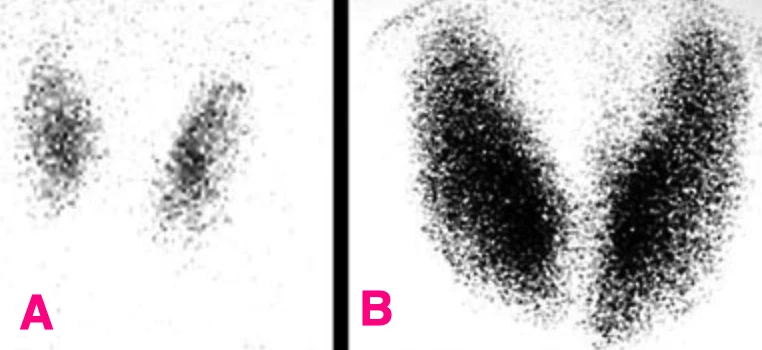
Show answer and explanation
Correct answer: B. Anti-thyrotropin receptor antibodies
The answer
The stem doesn’t name the imaging, because you’re expected to recognize a radioactive iodine uptake scan, and USMLE can show you these. Image A on the left is a healthy control. Image B on the right, our patient, shows diffusely increased uptake, and diffusely increased uptake means Graves disease.
In Graves disease, activating antibodies bind the TSH receptor, also called the thyrotropin receptor. So the gland takes up more iodine and makes more thyroid hormone. Thyrotropin is simply another way of writing TSH, so anti-thyrotropin receptor antibodies, option B, are what this patient has.
Why A, C, D and E are wrong
A, anti-microsomal antibodies, points to Hashimoto thyroiditis, which would show less uptake than the normal scan on the left. You don’t need to be an endocrinologist to see that B shows more. C and D, low and high calcium, are parathyroid distractors and do not explain this scan. E, a post-viral state, points to de Quervain thyroiditis, where uptake is low even when the patient is hyperthyroid, but B shows increased uptake.
High-yield tips
★ High-yield tip #1
Thyrotropin means TSH
Thyrotropin is another way of writing TSH, thyroid-stimulating hormone. That’s not being fancy. You have to know it, and students get it wrong because they didn’t know it meant TSH.
★ High-yield tip #2
Graves mechanism and labs
The mechanism is activating antibodies against the TSH receptor, also called the thyrotropin receptor. So the gland takes up more iodine and makes more thyroid hormone. T3 and T4 go up, and TSH is suppressed: primary hyperthyroidism. Contrast Hashimoto, a primary hypothyroidism, where T4 is down and TSH is up.
★ High-yield tip #3
Eyes and skin in Graves
Graves can cause proptosis, also called exophthalmos, a protrusion of the eyes from glycosaminoglycan deposition, and pretibial myxedema. That’s because orbital and dermal fibroblasts also have TSH receptors. The antibodies activate them, and they secrete GAGs. Know this mechanism.
★ High-yield tip #4
Only Graves causes them
Among the causes of hyperthyroidism, you’ll only see exophthalmos and pretibial myxedema in Graves disease. Toxic adenoma, toxic multinodular goiter, and de Quervain subacute granulomatous thyroiditis don’t cause them. They are specific for Graves on USMLE because of the mechanism we just described.
★ High-yield tip #5
Hashimoto uptake and histology
Anti-microsomal antibodies, also called anti-thyroid peroxidase antibodies, point to Hashimoto thyroiditis, where you can also see anti-thyroglobulin antibodies. That’s hypothyroidism, so uptake is usually decreased, though it can vary, sometimes described as patchy: not necessarily zero, just less than a normal scan. Besides the antibodies, know that Hashimoto shows a lymphocytic infiltrate, since they can ask you for the histology.
★ High-yield tip #6
Calcium distractors
On the exam’s reference range, normal calcium is 8.4 to 10.2 mg/dL. Low and high calcium are here as distractors, for students who mix up the parathyroid and the thyroid. There are four parathyroid glands on the back of the thyroid. Hypoparathyroidism, for example after thyroidectomy removes the parathyroids, causes low calcium.
★ High-yield tip #7
DiGeorge syndrome
You can also get low calcium in DiGeorge syndrome, with aplasia of the third and fourth pharyngeal pouches. Those pouches form the parathyroid glands and the thymus, so the result is hypocalcemia.
★ High-yield tip #8
High and low calcium in hyperparathyroidism
Hypercalcemia could be primary hyperparathyroidism, from a parathyroid adenoma or multigland hyperplasia. Note that in secondary hyperparathyroidism, such as from renal failure, calcium is actually low. That could also be what choice C refers to.
★ High-yield tip #9
Spotting de Quervain
A post-viral state points to de Quervain thyroiditis. The viral infection is mentioned in only about half of vignettes. They can just say a 32-year-old woman has a painful, tender thyroid gland, with no other information, and that’s de Quervain until proven otherwise. She can be hyperthyroid, with tachycardia and heat intolerance.
★ High-yield tip #10
Uptake in de Quervain
In de Quervain thyroiditis, uptake is low. The gland isn’t making new thyroid hormone; inflammation lets preformed hormone leak into the blood. Uptake stays low even when the patient is hyperthyroid, and students get that wrong.
Sources: StatPearls: Graves Disease; StatPearls: I-123 Uptake; Endotext: Diagnosis and Treatment of Graves’ Disease; MedlinePlus: Radioactive Iodine Uptake; MedlinePlus: TSH Test; StatPearls: Physiology, Thyroid Stimulating Hormone; StatPearls: Hypothyroidism; MedlinePlus: Thyroid Peroxidase Antibody; StatPearls: Hashimoto Thyroiditis; NBME Laboratory Reference Values; StatPearls: Primary Hyperparathyroidism; MedlinePlus: Calcium Blood Test; StatPearls: Anatomy, Head and Neck, Parathyroid; StatPearls: Physiology, Parathyroid Hormone; StatPearls: De Quervain Thyroiditis; StatPearls: Hyperthyroidism; Immunological Aspects of Graves’ Ophthalmopathy (review)
Question 18
A graduate student in a cell biology laboratory is studying the binding sites of various hormones, in particular thyroid hormone. Which of the following is most likely to demonstrate binding most similar to thyroid hormone?
Show answer and explanation
Correct answer: E. Vitamin A
The answer
Vitamin A is the match. Memorize this group of three: vitamin A, vitamin D and thyroid hormone all bind intranuclear receptors. They are lipophilic, so they cross the cell membrane without trouble, move through the cytosol, and pass into the nucleus.
Their receptors sit on the DNA at sites called response elements. There, the thyroid hormone receptor, the vitamin D receptor and the retinoic acid receptor each pair up with a partner, the retinoid X receptor (RXR), to form heterodimers. They grip the DNA through zinc finger motifs, and hormone binding upregulates gene transcription. This is the first thing the exam wants you to know.
Why A, B, C and D are wrong
A, adrenocorticotropic hormone, and D, prolactin, are peptide hormones, so they bind receptors on the cell membrane. B, insulin, is a peptide hormone too, and its membrane receptor is a tyrosine kinase. C, progesterone, is a steroid hormone, taught to bind receptors in the cytosol, so it does not match thyroid hormone.
High-yield tips
★ High-yield tip #1
Steroid hormones and estrogen
Most steroid hormones, such as testosterone, progesterone, cortisol and aldosterone, are taught to bind receptors in the cytosol, which then move into the nucleus. Estrogen is the odd one out. It is a steroid hormone, but it mostly binds receptors in the nucleus.
★ High-yield tip #2
Peptide hormones
Nearly every other hormone you can think of, such as prolactin, growth hormone, insulin, TSH, ACTH, LH and FSH, is a peptide hormone. Peptide hormones cannot cross the cell membrane, so they bind receptors on the cell membrane.
★ High-yield tip #3
The insulin receptor
Insulin is a peptide hormone too, so it binds a cell membrane receptor, and that receptor is a tyrosine kinase. Insulin directly increases tyrosine kinase activity and indirectly increases serine-threonine kinase activity. It also decreases protein breakdown, because insulin is a fed-state hormone, not a fasting-state hormone.
★ High-yield tip #4
The reverse question
Expect a twist on this question. A researcher finds that a hormone binds a cell membrane receptor, and you are asked which hormone it is. Four options are steroid hormones and one, such as prolactin, growth hormone or ACTH, is not. Even if you don’t remember the binding, pick the odd one out, or simply recall that peptide hormones bind membrane receptors.
★ High-yield tip #5
Recap
To recap: vitamin A, vitamin D and thyroid hormone bind intranuclear receptors through zinc finger motifs and upregulate transcription. Most steroid hormones bind receptors in the cytosol. Estrogen, although a steroid, mainly binds intranuclear receptors. Peptide hormones, which means nearly all other hormones, bind cell membrane receptors.
Sources: The Cell: A Molecular Approach, Signaling Molecules and Their Receptors; NCBI Conserved Domains: NR_DBD_RXR; StatPearls: Physiology, Thyroid Hormone; Endotext: Glucocorticoid Receptor; StatPearls: Physiology, Cortisol; StatPearls: Physiology, Aldosterone; StatPearls: Physiology, Endocrine Hormones; StatPearls: Physiology, Adrenocorticotropic Hormone (ACTH); StatPearls: Physiology, Prolactin; StatPearls: Biochemistry, Insulin Metabolic Effects; Endotext: The Insulin Receptor and Its Signal Transduction Network
Question 19
A 31-year-old woman visits her primary care clinic for a 3-month history of periodic palpitations and restlessness. Vitals are: temperature 99.0°F; heart rate 90/min; respiratory rate 16/min; blood pressure 120/80 mm Hg. She has a history of hypothyroidism, which she manages by self-administering exogenous triiodothyronine. Which of the following sets of findings is most likely to be seen acutely in this patient?
Show answer and explanation
Correct answer: G. ↓ TSH; ↑ T3; ↓ T4
The answer
Her history of hypothyroidism will confuse some people. The question asks about her acute findings, and she is giving herself T3, triiodothyronine. She is restless, with palpitations and a heart rate of 90. So we are not looking for hypothyroid labs. She is clearly in a hyperthyroid state from the extra hormone.
Extra T3 feeds back on the hypothalamus and the anterior pituitary, suppressing TRH and TSH, so TSH goes down. T3 goes up, simply because she is taking it. The twist is T4, which goes down: with TSH suppressed, the thyroid makes less of its own hormone, and extra T3 does not make T4. That is option G.
Why A, B, C, D, E, F and H are wrong
A, B, C and D all show a high TSH, but the T3 she takes suppresses TSH; of these, D is the closest pattern for untreated Hashimoto thyroiditis. E, ↓ TSH with ↑ T3 and ↑ T4, fits levothyroxine, which is exogenous T4. F and H show a low T3, but she is taking T3.
High-yield tips
★ High-yield tip #1
Why T4 falls when you take T3
The key rule: T4 can be converted peripherally to T3, but extra T3 does not make T4. So when someone takes T3 alone, TSH is suppressed, the thyroid makes less of its own T3 and T4, the T3 being taken keeps T3 high, and nothing replaces the missing T4. T4 goes down, not up.
★ High-yield tip #2
Levothyroxine gives a different pattern
Compare a patient taking levothyroxine, which is exogenous T4. TSH would still be suppressed, but T3 and T4 would both rise, because the T4 she takes is converted peripherally to T3. That pattern, ↓ TSH with ↑ T3 and ↑ T4, is choice E.
★ High-yield tip #3
Untreated Hashimoto thyroiditis
Now compare hypothyroidism that is not being treated with T3 or T4, for example Hashimoto thyroiditis on its own. TSH would be high and T4 low; T3 falls less often. Among these options, the closest pattern is choice D, ↑ TSH with ↓ T3 and ↓ T4.
Sources: Endotext: Evaluation of Thyroid Function in Health and Disease; StatPearls: Hypothyroidism; StatPearls: Thyrotoxicosis; Hyperthyroidism (Overactive Thyroid); CYTOMEL (liothyronine sodium) tablets, prescribing information; StatPearls: Physiology, Thyroid Hormone; StatPearls: Hashimoto Thyroiditis
Question 20
A 33-year-old woman presents to an urgent care clinic with a 2-day history of palpitations, restlessness, and neck tenderness. Heart rate is 90/min. Thyroid-stimulating hormone (TSH) is 0.3 mIU/L. A radioiodine-131 scan shows reduced uptake. Which of the following is the most likely explanation for this patient’s findings?
Show answer and explanation
Correct answer: D. Increased release of pre-formed thyroid hormone
The answer
She clearly has hyperthyroidism: restlessness, palpitations, and a TSH of 0.3, which is below the normal range. The surprise is the scan: she is hyperthyroid, yet radioiodine uptake is reduced. The key clue is her neck tenderness. A tender, painful thyroid is de Quervain thyroiditis until proven otherwise.
Here we have neck tenderness, hyperthyroidism, and reduced uptake. The mechanism is inflammation of the thyroid gland, which damages the follicles and releases stored, preformed hormone into the blood. But the gland is not producing new hormone, which is why uptake is low. Increased uptake means increased production of new thyroid hormone.
Why A, B, C and E are wrong
A, antibodies against the TSH receptor, is Graves’ disease, with diffusely increased uptake. B, anti-microsomal antibodies, is Hashimoto thyroiditis, which causes hypothyroidism with a high TSH. C, exogenous levothyroxine, also lowers TSH and uptake, but neck tenderness is not classic for it. E, toxic adenomatous autonomous secretion, is a toxic adenoma, with increased uptake in one focal nodule.
High-yield tips
★ High-yield tip #1
De Quervain thyroiditis
A tender, painful thyroid is de Quervain thyroiditis until proven otherwise. Know its other names: subacute granulomatous thyroiditis, or simply subacute thyroiditis. Many patients have had a viral upper respiratory infection 2 to 8 weeks before, but not all, so the question may leave it out, so do not rely on it as a crutch.
★ High-yield tip #2
Increased uptake means new hormone
Increased uptake means the gland is making new thyroid hormone. Graves’ disease, from antibodies against the TSH receptor, shows diffusely increased uptake. A toxic adenoma, described here wordily as toxic adenomatous autonomous secretion, shows increased uptake in one focal area, the nodule. Both cause hyperthyroidism with a suppressed TSH.
★ High-yield tip #3
Hashimoto thyroiditis
B, anti-microsomal antibodies, points to Hashimoto thyroiditis. These are also called anti-thyroid peroxidase antibodies, and anti-thyroglobulin antibodies can be present too. Hashimoto causes hypothyroidism, so TSH should be elevated. Uptake into the gland can be reduced as well, so it is the high TSH that separates it from de Quervain.
★ High-yield tip #4
Factitious thyrotoxicosis
Taking thyroid hormone, such as levothyroxine, is called factitious thyrotoxicosis. It suppresses TSH and reduces uptake into the thyroid gland, just like thyroiditis, so it is a tempting choice. But neck tenderness is not classic for it, so when the thyroid is tender, look for a better answer.
★ High-yield tip #5
Know the normal TSH range
You may not be given normal ranges, especially on Step 2 CK, so know that a normal TSH is roughly 0.4 to 4.8 mIU/L, varying slightly by lab. A value below that range, with symptoms such as palpitations and restlessness, points to hyperthyroidism.
Sources: StatPearls: De Quervain Thyroiditis; StatPearls: Thyroiditis; StatPearls: Thyrotoxicosis; TSH test; Hyperthyroidism (Overactive Thyroid); Endotext: Hashimoto’s Thyroiditis; StatPearls: Hashimoto Thyroiditis
Question 21
A 38-year-old woman is seen in an outpatient clinic for a 5-month history of menstrual irregularities and restlessness. Heart rate is 90/min. Physical examination shows exophthalmos. A radioiodine uptake scan is shown: “A” is a normal scan, and “B” is the patient’s scan. The most likely diagnosis is most immunologically similar to which of the following?
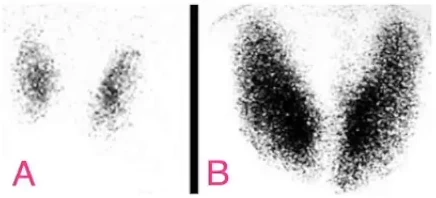
Show answer and explanation
Correct answer: C. Bullous pemphigoid
The answer
Restlessness, menstrual irregularities, and especially exophthalmos hand you the diagnosis: Graves’ disease. Making that diagnosis is pass level. The scan agrees: compared with the normal scan, the patient’s gland shows diffusely increased uptake, which is what Graves’ disease looks like on an iodine uptake scan.
Graves’ disease is a type II hypersensitivity, which means antibodies directed against your own cells, tissues or receptors. Here, antibodies called TSI bind and activate the TSH receptor on the thyroid. Bullous pemphigoid is also type II, with autoantibodies against hemidesmosomes in the basement membrane of the skin, so it is the most immunologically similar.
Why A, B, D and E are wrong
A, anaphylaxis, is a type I hypersensitivity, mediated by IgE. B, the Arthus reaction, and E, serum sickness, are type III, caused by immune complexes. D, contact dermatitis, is type IV, a T cell response. None of them is type II like Graves’ disease.
High-yield tips
★ High-yield tip #1
The Graves mechanism
In Graves’ disease, antibodies called thyroid-stimulating immunoglobulins (TSI) bind to and activate the TSH receptor. The result is diffuse activation of the whole thyroid gland. Endogenous TSH is suppressed, while T3 and T4 are high.
★ High-yield tip #2
Bullous pemphigoid versus pemphigus vulgaris
Bullous pemphigoid has autoantibodies against hemidesmosomes, specifically the bullous pemphigoid antigen, in the basement membrane of the skin. In contrast, pemphigus vulgaris has antibodies against desmosomes, specifically the desmoglein proteins within the epidermis. Knowing both is pass level. This question is a little trickier because it asks you to integrate them with Graves’ disease through the type of hypersensitivity.
★ High-yield tip #3
Other type 2 reactions
Other high-yield type II hypersensitivities to know are pernicious anemia, idiopathic thrombocytopenic purpura, and heparin-induced thrombocytopenia. Like Graves’ disease and bullous pemphigoid, each is driven by antibodies directed against the body’s own cells or proteins.
★ High-yield tip #4
Anaphylaxis
A, anaphylaxis, is a type I hypersensitivity. An antigen, such as a bee sting or peanut protein, binds IgE that is already attached to the surface of mast cells and basophils. The bound IgE molecules cross-link, the cells degranulate and release histamine, and the result is hypotension and swelling.
★ High-yield tip #5
The Arthus reaction
B, the Arthus reaction, is a type III hypersensitivity caused by immune complexes. It follows an injection, such as a vaccine, with local swelling, redness and pain at the injection site. It is not immediate like type I, but appears within a few hours and usually peaks within 24 hours. Avoid calling it delayed, a word that suggests the T cell response of type IV.
★ High-yield tip #6
Contact dermatitis
D, contact dermatitis, is a type IV hypersensitivity, a T cell response. Classic triggers are nickel from the back of a watch, sunscreen, and latex. A vignette might describe a woman working in an anatomy lab, or a nurse in a new facility, with diffuse redness on her hands. The PPD test for tuberculosis is also type IV.
★ High-yield tip #7
Type 4 timing
Poison ivy, oak and sumac are also high-yield, with linear rows of vesicles. Type IV reactions are delayed, meaning they do not occur immediately. The rash takes at least a day, and often a few days, to appear after contact.
★ High-yield tip #8
Serum sickness
E, serum sickness, is type III, the same as the Arthus reaction, so it is driven by immune complexes. Classically a drug or foreign protein is given, and fever, rash and joint pain follow, usually one to two weeks after a first exposure, or within a week if the patient was exposed before. Type III reactions can also follow infections, such as hepatitis B and C.
Sources: StatPearls: Graves Disease; StatPearls: Type II Hypersensitivity Reaction; Immunobiology (Janeway), 5th ed: Autoimmune responses are directed against self antigens; StatPearls: Bullous Pemphigoid; StatPearls: Type I Hypersensitivity Reaction; StatPearls: Anaphylaxis; StatPearls: Type III Hypersensitivity Reaction; StatPearls: Type IV Hypersensitivity Reaction; StatPearls: Allergic Contact Dermatitis; MedlinePlus: Serum sickness; StatPearls: Pemphigus Vulgaris; StatPearls: Pernicious Anemia; StatPearls: Immune Thrombocytopenia; StatPearls: Heparin-Induced Thrombocytopenia
Question 22
A 2-day-old newborn has a heel prick screening test before going home from the hospital. It shows normal serum TSH, normal serum free T4, and decreased serum total T4. Which of the following is the most likely diagnosis?
Show answer and explanation
Correct answer: D. Globulin deficiency
The answer
This one-liner trips up a lot of students, but it is not hard. Take a step back and think about pregnancy, which seems unrelated. In pregnancy, we expect a normal TSH, a normal free T4 and an increased total T4. This newborn shows the exact inverse: normal TSH and free T4, but a decreased total T4.
What explains the pregnancy pattern? An increase in thyroxine-binding globulin, or TBG. So apply the same idea in reverse. If more TBG raises total T4, then less TBG lowers total T4 while TSH and free T4 stay normal. That is thyroxine-binding globulin deficiency, listed here as globulin deficiency.
Why A, B, C, E and F are wrong
A and B, anti-thyroid antibodies, and C, dysgenesis of thyroid follicles, cause true hypothyroidism, which would lower the hormone itself. E, sick euthyroid syndrome, is mainly a low T3 state with a raised reverse T3 during acute illness, and nothing here suggests an illness. F, thyrotropin deficiency, causes central hypothyroidism with a low free T4, but this newborn’s free T4 is normal. Only a change in a binding protein lowers total T4 while leaving free T4 and TSH normal.
High-yield tips
★ High-yield tip #1
TBG in pregnancy
In pregnancy, estrogen makes the liver produce more TBG. The extra TBG binds up free T4 in the blood. The pituitary senses the dip in free T4 and briefly raises TSH. Total T4 climbs until free T4 returns to normal, and then TSH settles back to normal too. Separately, high hCG late in the first trimester can briefly lower TSH.
★ High-yield tip #2
The pregnancy pattern on the exam
For the exam, just remember the end result: in pregnancy, TSH and free T4 are normal and total T4 is increased, because estrogen increases TBG. This is very high yield. A pediatric question like this one is really testing whether you know the pregnancy pattern, because the concept is the same, just in reverse.
★ High-yield tip #3
Thyrotropin and Graves
Thyrotropin is simply another name for TSH, thyroid-stimulating hormone. You may see the term in a tricky Graves disease question. There, the autoantibody that activates the TSH receptor is called thyroid-stimulating immunoglobulin, or TSI. A question might call it a thyrotropin receptor antibody, which means the same thing as a TSH receptor antibody.
★ High-yield tip #4
Sick euthyroid syndrome
Sick euthyroid syndrome is high yield. During acute stress, such as acute illness, recent surgery or trauma, less T4 is converted into T3. One proposed reason is the acute rise in cortisol. T3 falls, and T4 is shunted toward an inactive form called reverse T3, which rises. TSH and T4 usually stay normal.
★ High-yield tip #5
The sick euthyroid pattern
The sick euthyroid pattern is decreased T3, increased reverse T3, and usually normal TSH and T4. Students often miss this diagnosis, but it does appear on practice exams.
★ High-yield tip #6
Recap
To recap: in pregnancy, TBG goes up, TSH and free T4 are normal, and total T4 is increased. So in a child with a normal TSH, a normal free T4 and a decreased total T4, think thyroxine-binding globulin deficiency.
Sources: StatPearls: Thyroxine-Binding Globulin Deficiency; Inherited thyroxine-binding globulin deficiency; TBG blood test; PMC review: Thyroid hormone dysfunction during pregnancy: A review; Neonatal hypothyroidism; StatPearls: Congenital Hypothyroidism; TSH test; StatPearls: Graves Disease; StatPearls: Hypothyroidism; StatPearls: Euthyroid Sick Syndrome
Question 23
A 3-year-old boy is brought to the physician by his father for thyroid evaluation. His father reports that he has been a bit irritable. Vital signs are within normal limits. Physical examination is unremarkable. Serum TSH is 2.6 mIU/L (NR 0.5-5.0), free T4 is 1.3 ng/dL (NR 0.8-1.8), and total T4 is 3 μg/dL (NR 5-12). Which of the following is the most likely diagnosis?
Show answer and explanation
Correct answer: E. Thyroid-binding globulin deficiency
The answer
This child has a normal TSH and a normal free T4, but a low total T4. That can look confusing at first. Take a step back and think about pregnancy, which seems unrelated but is very high yield. In pregnancy, TSH and free T4 are normal and total T4 is increased.
Now apply that concept here. This child has the same pattern in reverse: TSH and free T4 are normal, but total T4 is decreased. The simplest explanation is that TBG is decreased. So the diagnosis is thyroid-binding globulin deficiency.
Why A, B, C and D are wrong
A, cretinism, is congenital hypothyroidism, but this child has a normal examination and a normal free T4. B, congenital subclinical hypothyroidism, is a made-up distractor. C, euthyroid sick syndrome, lowers T3 after surgery, trauma or ventilator weaning, none of which this child has. D, silent thyroiditis, is a painless autoimmune thyroiditis, more common in women and possible after childbirth, with hyperthyroid then hypothyroid values.
High-yield tips
★ High-yield tip #1
Thyroid tests in pregnancy
Why is total T4 increased in pregnancy? Estrogen makes the liver produce more thyroxine-binding globulin, or TBG. More TBG means more bound T4, so total T4 rises while TSH and free T4 stay normal. This combination of findings in pregnancy is extremely high yield.
★ High-yield tip #2
Cretinism
Cretinism is congenital hypothyroidism. Endemic cretinism comes from iodine deficiency in areas where iodine is scarce, while in countries with enough iodine the most common cause is a thyroid gland that did not develop fully. Expect a child, usually in the first year of life, with intellectual disability, a pot belly, a large tongue and poor bone growth.
★ High-yield tip #3
Why cretinism harms the brain
Why the intellectual disability? Thyroid hormone is needed for normal brain development, including myelination, so untreated congenital hypothyroidism harms the developing brain. It is also needed for bone growth.
★ High-yield tip #4
Subclinical hypothyroidism
Congenital subclinical hypothyroidism is a made-up distractor. Subclinical hypothyroidism in general, not congenital, is classically an adult with an elevated TSH but normal T3 and T4. If a vignette describes an asymptomatic person with that pattern, it is subclinical hypothyroidism. Most cases are monitored rather than treated.
★ High-yield tip #5
Euthyroid sick syndrome
Euthyroid sick syndrome is an underrated, high-yield diagnosis. Think of it in a patient who has had surgery, recent trauma, or is being weaned off a ventilator. TSH and T4 show no change, T3 is decreased, and reverse T3 is increased.
★ High-yield tip #6
Why euthyroid sick happens
Several mechanisms are proposed. One is that cortisol rises acutely during stress, and less T4 is converted into T3. So T3 goes down, and T4 is shunted to an inactive form called reverse T3, which goes up. TSH and T4 stay normal. Students often skip this diagnosis because it seems odd, and then it shows up on the exam.
★ High-yield tip #7
Silent thyroiditis
Silent thyroiditis is tested less often. It is a painless autoimmune thyroiditis, and its postpartum form looks like Hashimoto thyroiditis under the microscope. Picture a woman with no previous thyroid problems who, within a year of giving birth, develops hyperthyroid and then hypothyroid values with a nontender thyroid. For example, she gave birth four months ago and now has hypothyroid labs.
★ High-yield tip #8
Reason from pregnancy
You do not need to memorize a list of rare conditions. Pregnancy values are so high yield that you can reason from them: TBG goes up in pregnancy, so the reverse pattern, a low total T4 with normal TSH and free T4, means TBG is down. Thyroid-binding globulin deficiency does appear in Step 2 CK pediatrics questions.
Sources: StatPearls: Thyroxine-Binding Globulin Deficiency; Inherited thyroxine-binding globulin deficiency; TBG blood test; StatPearls: Congenital Hypothyroidism; Neonatal hypothyroidism; StatPearls: Subclinical Hypothyroidism; StatPearls: Euthyroid Sick Syndrome; StatPearls: Postpartum Thyroiditis; MedlinePlus: Silent thyroiditis; PMC review: Thyroid hormone dysfunction during pregnancy: A review
Question 24
A 47-year-old man comes to his primary care clinic for a routine health maintenance examination. Palpation of the thyroid gland reveals a nodule. TSH is within normal limits. Biopsy with Congo red staining confirms the diagnosis. Serum studies show elevation of a particular hormone. Which of the following is the most likely normal function of this hormone?
Show answer and explanation
Correct answer: A. Inhibition of osteoclasts
The answer
The key clues are a thyroid nodule and a biopsy confirmed with Congo red staining. Congo red stains amyloid, which shows apple-green birefringence under polarized light, and that points to medullary thyroid carcinoma. Its amyloid is made from calcitonin, and this cancer arises from the parafollicular C cells, the thyroid cells that produce calcitonin.
So the elevated hormone is calcitonin, often raised in the serum because the tumor is made of calcitonin-producing C cells. Calcitonin is released when serum calcium is high, and its normal function is to inhibit osteoclast activity, so less calcium leaches out of bone. That is option A.
Why B, C, D and E are wrong
B, maintenance of the corpus luteum, is the job of hCG, human chorionic gonadotropin. C, myelin development in neonates, is a function of thyroid hormone, a distractor for students who see a thyroid cancer. D, stimulation of Leydig cells, describes luteinizing hormone. E, stimulation of Sertoli cells, describes follicle-stimulating hormone.
High-yield tips
★ High-yield tip #1
Embryologic origin of thyroid cells
Embryologic origin is high yield. The follicular cells, which make the actual thyroid hormones T3 and T4, come from endoderm. The parafollicular C cells that produce calcitonin are classically taught as neural crest in origin. So for medullary thyroid carcinoma, know the neural crest link.
★ High-yield tip #2
Medullary carcinoma buzzwords
Buzzwords for medullary thyroid carcinoma: neural crest cells, parafollicular C cells, calcitonin, amyloid, Congo red stain and apple-green birefringence. Calcitonin is often elevated in the serum, because the tumor is made of calcitonin-producing C cells.
★ High-yield tip #3
Calcitonin is not just the opposite of PTH
Calcitonin works by inhibiting osteoclast activity. A common mistake is to think calcitonin is simply the opposite of PTH. PTH raises blood calcium partly by driving bone resorption, through osteoclasts. Calcitonin is released when serum calcium is high, and it lowers calcium mainly by inhibiting osteoclasts, so less calcium leaches out of bone, and by increasing calcium excretion in the urine.
★ High-yield tip #4
Bisphosphonates
A related point: bisphosphonates also inhibit osteoclast activity. Examples are alendronate for osteoporosis, and intravenous drugs such as zoledronic acid for hypercalcemia of malignancy. They work through a different mechanism than calcitonin, but the end effect on bone resorption is similar.
★ High-yield tip #5
Hereditary medullary carcinoma
Medullary thyroid carcinoma can be hereditary. If a question only says the patient’s father and brother had thyroid cancer and asks for the likely type, choose medullary thyroid carcinoma. Hereditary cases come from RET gene mutations on chromosome 10. Some families have only medullary thyroid cancer, a form now considered a variant of MEN 2A.
★ High-yield tip #6
MEN 2
It also occurs in multiple endocrine neoplasia type 2. Both MEN 2A and MEN 2B have medullary thyroid carcinoma and pheochromocytoma. MEN 2A adds parathyroid hyperplasia or adenoma. MEN 2B adds mucosal neuromas and marfanoid body habitus.
★ High-yield tip #7
Cretinism
In cretinism, or congenital hypothyroidism, poor myelin development causes intellectual disability. Endemic cretinism comes from iodine deficiency in areas where iodine is scarce. Thyroid hormone is needed for myelination, bone development and general metabolism.
★ High-yield tip #8
Leydig and Sertoli cells
Choice D, stimulation of Leydig cells, describes luteinizing hormone, LH. Leydig cells are in males, and the female equivalent is the theca cells. Choice E, stimulation of Sertoli cells in males, describes follicle-stimulating hormone, FSH. The female equivalent is the granulosa cells.
Sources: StatPearls: Medullary Thyroid Cancer; Revised ATA Guidelines for the Management of Medullary Thyroid Carcinoma (2015); StatPearls: Calcitonin; StatPearls: Physiology, Calcium; StatPearls: Amyloidosis; StatPearls: Physiology, Parathyroid Hormone; StatPearls: Human Chorionic Gonadotropin; StatPearls: Physiology, Thyroid Hormone; StatPearls: Congenital Hypothyroidism; StatPearls: Physiology, Luteinizing Hormone; StatPearls: Physiology, Follicle Stimulating Hormone; StatPearls: Embryology, Thyroid; StatPearls: Bisphosphonate; Zometa (zoledronic acid) prescribing information; StatPearls: Multiple Endocrine Neoplasia Type 2; MedlinePlus: Multiple endocrine neoplasia (MEN) II; MedlinePlus: Congenital hypothyroidism
Question 25
A 52-year-old woman comes to her family physician for a routine health maintenance examination. Palpation of the thyroid gland reveals a small nodule. A serum TSH is ordered and is high. Which of the following is the next best step in management?
Show answer and explanation
Correct answer: C. Fine-needle aspiration
The answer
The clue is a thyroid nodule with a high TSH. A normal or elevated TSH means the patient is not hyperthyroid, because hyperthyroidism would suppress the TSH. So the nodule is not an overactive hot nodule, and it could be a cancer.
Nodules that make thyroid hormone, called hot nodules, rarely harbor cancer, and nodules that do not are called cold nodules. A higher TSH, even within the upper part of the normal range, is linked to a higher risk of malignancy. So the next best step is fine-needle aspiration, the procedure of choice for finding out whether there is carcinoma.
Why A, B, D and E are wrong
A, echocardiography, is an ultrasound of the heart and plays no role in a thyroid nodule workup. B, an excisional biopsy, is not the next step, because fine-needle aspiration is the procedure of choice. D, levothyroxine, does nothing to check the nodule for cancer. E, a radioiodine uptake scan, is the next step only when the TSH is low.
High-yield tips
★ High-yield tip #1
Palpate first
This is the classic thyroid nodule workup, very high yield across Step 2 CK surgery, family medicine and internal medicine. It may sound obvious, but if a patient comes to the clinic and you are asked for the first step in evaluating for thyroid cancer, the answer is palpation of the thyroid gland, not a serum TSH.
★ High-yield tip #2
TSH comes next
After you palpate the gland and find a nodule, then you order a serum TSH. Guidelines recommend measuring TSH during the initial evaluation of every patient with a thyroid nodule. The TSH result then decides the next best step for the nodule.
★ High-yield tip #3
Echocardiography versus thyroid ultrasound
Students get this wrong by choosing echocardiography, an ultrasound of the heart. It plays no role in a thyroid nodule workup. Do not confuse it with ultrasound of the thyroid itself. Guidelines recommend thyroid ultrasound for every patient with a nodule, and FNA is usually done under ultrasound guidance, so an answer like ultrasound-guided FNA can also be correct.
★ High-yield tip #4
Low TSH means a scan
In contrast, if the TSH is decreased, the nodule may be hot. Hot nodules secrete hormone and are very rarely cancers. So instead of FNA, the next step is a radioiodine uptake scan, which tells us more about what is going on.
★ High-yield tip #5
Uptake patterns
If the scan shows uptake in the single nodule alone, that is a toxic adenoma. Diffuse uptake throughout the gland is consistent with Graves disease. Uptake in multiple nodules is toxic multinodular goiter. Remember, order the radioiodine uptake scan only when the TSH is low.
★ High-yield tip #6
The nodule algorithm
To sum up: the first step is palpating the thyroid. If that is not listed, check a serum TSH. If TSH is normal or elevated, the answer is fine-needle aspiration, or ultrasound-guided FNA. Echocardiography is always wrong here. If TSH is decreased, the answer is a radioiodine uptake scan.
Sources: 2015 ATA Management Guidelines for Adult Patients with Thyroid Nodules and Differentiated Thyroid Cancer; StatPearls: Thyroid Nodule; MedlinePlus: Thyroid nodule; StatPearls: Hyperthyroidism; MedlinePlus: Echocardiogram; MedlinePlus: Thyroid scan; StatPearls: Thyrotoxicosis
Question 26
A 61-year-old man comes to his primary care clinic for an annual health check. He reports generalized tiredness. BMI is 27. Thyroid function studies show a TSH of 6.7 mIU/L (NR 0.5-5.0); serum T3 and T4 are within normal limits. Antibody screening is performed and is negative. Which of the following is the most appropriate management for this patient?
Show answer and explanation
Correct answer: I. Schedule follow-up appointment in 3 months
The answer
This patient has subclinical hypothyroidism: the TSH is raised, but T3 and T4 are normal. For Steps 1 and 2, you mainly need to know this pattern of arrows, and many students don’t. So remember it: TSH goes up, while T3 and T4 stay normal.
Most of the time, we do not treat subclinical hypothyroidism, and if you are not sure whether a patient meets the criteria, go with no treatment. His TSH of 6.7 is between 5 and 10, below the treatment threshold of 10, and his antibody screen is negative. Even with tiredness, the TSH is first repeated in 2 to 3 months to confirm it stays high, so schedule a follow-up appointment in 3 months.
Why A to H are wrong
Because his raised TSH has not yet been confirmed on a repeat test, he should not be started on a drug today. That rules out every one-week or two-week trial, options A through H, whatever the drug or the dose. Watchful follow-up is the right call.
High-yield tips
★ High-yield tip #1
When to treat, TSH above 10
Guidelines list a few situations where we do treat subclinical hypothyroidism with levothyroxine. This matters more for Step 3, but it is worth knowing. The first is a TSH above 10.
★ High-yield tip #2
Other reasons to treat
Other indications include a positive antibody screen for Hashimoto thyroiditis, meaning antibodies against thyroid peroxidase, also called anti-microsomal antibodies, as well as pregnancy and clear hypothyroid symptoms. Before treating, the TSH is first repeated in 2 to 3 months to confirm that it stays high.
★ High-yield tip #3
Subclinical hypothyroidism versus euthyroid sick syndrome
Students often confuse this pattern with euthyroid sick syndrome. In euthyroid sick syndrome, TSH and T4 are usually normal, T3 is low, and reverse T3 is high. In subclinical hypothyroidism, TSH is high, while T3 and T4 are normal. Keep these two sets of arrows apart.
Sources: StatPearls: Subclinical Hypothyroidism; StatPearls: Hashimoto Thyroiditis; StatPearls: Hypothyroidism; MedlinePlus: Thyroid peroxidase antibody; StatPearls: Euthyroid Sick Syndrome
Question 27
A 41-year-old man in the intensive care unit is being weaned off a ventilator and has his thyroid function evaluated. His reverse T3 (rT3) is elevated. He is afebrile. Vitals are stable and within normal limits. Regarding his other thyroid function values, which of the following combinations is most likely in this patient?
Show answer and explanation
Correct answer: H. ↔ TSH; ↓ T3; ↔ T4
The answer
The clues are a critically ill patient, being weaned off a ventilator in intensive care, with an elevated reverse T3. That points to euthyroid sick syndrome, also known as nonthyroidal illness syndrome, where the thyroid gland itself is healthy.
Now the values. Reverse T3 is elevated, as the question tells you. Regular T3 is decreased. TSH and T4 are both normal. So once more: normal TSH and T4, low T3, and high reverse T3. That is option H.
Why A, B, C, D, E, F, G and I are wrong
Every other combination breaks the pattern. Options A to F have an abnormal TSH, G has a high T3, and I has a low T4 with a normal T3. Only H matches euthyroid sick syndrome: normal TSH, low T3 and normal T4.
High-yield tips
★ High-yield tip #1
An underrated diagnosis
Euthyroid sick syndrome, also known as nonthyroidal illness syndrome, is one of the most underrated high-yield diagnoses for Steps 1, 2 and 3. Resources often cover Graves disease, Hashimoto thyroiditis and de Quervain thyroiditis, but rarely this one, so students don’t recognize it when it appears.
★ High-yield tip #2
When to suspect euthyroid sick syndrome
Think of this diagnosis when the patient has recently had surgery or trauma, or is critically ill, for example in intensive care. One Step 2 CK level question describes a patient being weaned off a ventilator.
★ High-yield tip #3
Why the values change
During stress, high cortisol and inflammatory signals slow the enzyme that converts T4 into active T3 in the tissues, so regular T3 falls. T4 does not build up, because more of it is turned into reverse T3, an inactive form, which is also cleared more slowly. That is why reverse T3 rises. The normal T4 also helps keep TSH normal.
★ High-yield tip #4
A helpful comparison
This picture is driven by the acute illness and the body’s inflammatory response, not by disease of the thyroid itself. A useful way to remember it: euthyroid sick syndrome is roughly the thyroid version of anemia of chronic disease, where the liver makes an acute-phase protein, hepcidin, that locks iron away.
★ High-yield tip #5
Not subclinical hypothyroidism
Don’t confuse these values with subclinical hypothyroidism, where TSH is increased but T3 and T4 are normal. Euthyroid sick syndrome and subclinical hypothyroidism are often mixed up, so learn both sets of arrows side by side.
★ High-yield tip #6
Know the arrows
Take home this combination of arrows: normal TSH and T4, low T3 and high reverse T3. Euthyroid sick syndrome catches a lot of students off guard on the USMLE, but if you know it, it is an easy point.
Sources: StatPearls: Euthyroid Sick Syndrome; StatPearls: Physiology, Thyroid Hormone; StatPearls: Physiology, Hepcidin; StatPearls: Subclinical Hypothyroidism; StatPearls: Hashimoto Thyroiditis
Question 28
A 15-year-old girl is brought to her pediatrician by her father because of a 4-month history of fatigue. She has also been socializing less with friends. Vitals are: temperature 98.4F, HR 55, RR 14, BP 117/75. BMI is 23. Menses started at the age of 11 and have recently become longer and heavier. Her last menstrual period was two weeks ago. This patient’s diagnosis is most likely to demonstrate which of the following histologic findings?
Show answer and explanation
Correct answer: E. Lymphocytic infiltration
The answer
The clues point to hypothyroidism. She has four months of fatigue and is socializing less with friends, because hypothyroidism can cause low mood. Her heart rate of 55 is sinus bradycardia, under 60 beats per minute, a supporting clue. Her age of 15 and normal BMI of 23 do not argue against it.
Her menses started at 11, so they should be regular by now, but they have recently become longer and heavier. Heavy periods are characteristic of hypothyroidism.
This girl has Hashimoto thyroiditis, also known as chronic lymphocytic thyroiditis. So the answer is E, lymphocytic infiltration. If you remember the second name, you remember the histology: the gland has a lymphocytic infiltrate.
Why A, B, C and D are wrong
A, fibrotic stroma, fits Riedel thyroiditis, with a woody gland. B, follicular hyperplasia, points to Graves disease, which causes hyperthyroidism. C, caseating granulomas, point to tuberculosis or systemic fungal infections. D, non-caseating granulomas, fit de Quervain thyroiditis, with a tender, painful thyroid.
High-yield tips
★ High-yield tip #1
Histology still counts
This is a high-yield histology point for both Step 1 and Step 2. You don’t need to read a histology textbook, but a few facts like this one matter. Even a Step 2 level NBME, full of clinical questions, has asked for lymphocytic infiltration as the finding on biopsy in Hashimoto thyroiditis.
★ High-yield tip #2
Age and BMI
Hashimoto thyroiditis can occur in teenagers, and it shows up in NBME questions, so don’t rule it out as too young. The patient also does not need to be overweight, so a normal BMI should not trip you up.
★ High-yield tip #3
Bradycardia
USMLE vignettes like to give sinus bradycardia, defined as a rate under 60 beats per minute, in hypothyroidism. A healthy person can have a rate of 48 with no disease at all, but when you are thinking of hypothyroidism, a rate under 60 is a supporting clue.
★ High-yield tip #4
Menses in hypothyroidism
Periods can be irregular in the first years after menarche, but once cycles are established, new longer and heavier periods are a clue to hypothyroidism. Hypothyroidism can also stop periods altogether, so either pattern is a high-yield clue.
★ High-yield tip #5
Low mood
Hypothyroidism can cause low mood or depression, so a vignette may say the patient is socializing less with friends. Treating the hypothyroidism with levothyroxine, a T4 analog, can improve it. The USMLE can also say the patient makes little eye contact or is quiet during the exam, which reflects the same low mood.
★ High-yield tip #6
Hypothyroid myopathy
Know hypothyroid myopathy: a raised creatine kinase or proximal muscle weakness. The patient may have trouble getting up from a chair without help, or keeping the arms raised to brush her hair.
★ High-yield tip #7
Less obvious hypothyroid findings
Vignettes also like high cholesterol and raised liver transaminases, an odd finding that appears especially in Step 2 CK questions. Brittle hair, constipation, dry skin and weight gain can show up too, but those are the easy clues. Be aware of the less obvious findings as well.
★ High-yield tip #8
Riedel thyroiditis
A, fibrotic stroma, fits Riedel thyroiditis. The gland feels woody on exam because its stroma has become fibrotic, and the disease can affect other organs too. Like anaplastic carcinoma, it can extend into nearby structures such as the esophagus. But it is not the answer here.
★ High-yield tip #9
Follicular hyperplasia
B, follicular hyperplasia, may sound strange. Are we talking about the ovaries? No, this is clearly the thyroid. Follicular hyperplasia points to Graves disease, which causes hyperthyroidism, so it does not fit this patient.
★ High-yield tip #10
De Quervain thyroiditis
C and D test the two kinds of granulomas. Non-caseating granulomas fit de Quervain thyroiditis, also called subacute granulomatous thyroiditis. Expect a tender, painful thyroid after a viral infection. The question may not mention the infection, since not every patient reports one, but a painful thyroid on the USMLE means de Quervain.
★ High-yield tip #11
Caseating granulomas
Caseating granulomas point to tuberculosis, for example in the lungs, or to systemic fungal infections. Mycobacteria and fungi only rarely infect the thyroid, mostly in immunocompromised patients, so caseating granulomas are not the classic finding in thyroiditis.
★ High-yield tip #12
Take-home
Remember that the other name for Hashimoto thyroiditis is chronic lymphocytic thyroiditis. Not just on Step 1 but also on Step 2, they want you to know that the biopsy shows a lymphocytic infiltrate.
Sources: StatPearls: Hashimoto Thyroiditis; MedlinePlus: Chronic thyroiditis (Hashimoto disease); Endotext: Hashimoto’s Thyroiditis; StatPearls: Sinus Bradycardia; StatPearls: Hypothyroidism; StatPearls: Physiology, Menarche; MedlinePlus: Hypothyroidism; StatPearls: Secondary Amenorrhea; StatPearls: Levothyroxine; StatPearls: Riedel Thyroiditis; Histopathology of thyroid diseases review (PMC12422120); StatPearls: Thyrotoxicosis; StatPearls: Graves Disease; StatPearls: De Quervain Thyroiditis; StatPearls: Thyroiditis; Endotext: Acute and Subacute, and Riedel’s Thyroiditis; Clinical, macroscopic and microscopic characteristics of subacute thyroiditis (Head Neck Pathol 2018); StatPearls: Granuloma; StatPearls: Hypothyroid Myopathy; Hypothyroidism (Underactive Thyroid)
Question 29
A 55-year-old man comes to his primary care physician for a routine check-up. Vitals are: temperature 98.4F, HR 88, RR 16, BP 135/85. BMI is 26. He has lost approximately 10 pounds the past month. Serum TSH is 0.3 mIU/L (NR 0.5-5.0). The thyroid gland is small and non-palpable. Radioiodine uptake is decreased. What is the diagnosis?
Show answer and explanation
Correct answer: D. Surreptitious thyrotoxicosis
The answer
The clues are a suppressed TSH, a small, non-palpable thyroid and decreased radioiodine uptake. That is surreptitious thyrotoxicosis, also called factitious thyrotoxicosis: he is secretly taking thyroid hormone. Surreptitious means secretive.
The TSH is suppressed. Taking thyroid hormone shuts down the hypothalamic-pituitary axis, so TRH and TSH both fall. With little TSH to stimulate it, the thyroid becomes small and non-palpable and makes less of its own hormone. That is why radioiodine uptake is decreased: the gland has no need to make hormone that is already coming from outside.
The rest of the vignette supports it. His heart rate of 88 sits at the upper end of normal, and he has lost 10 pounds in the past month. A BMI of 26 doesn’t argue against it: someone with a BMI of 40 can take thyroid hormone too, so don’t be pulled in by the BMI.
Why A, B, C and E are wrong
A, Graves disease, also suppresses the TSH, but radioiodine uptake is increased and diffuse. B, Hashimoto thyroiditis, causes hypothyroidism with a high TSH. C, Riedel thyroiditis, is a rare fibrosis that makes the gland woody. E, thyroid failure, means primary hypothyroidism, which also raises the TSH.
High-yield tips
★ High-yield tip #1
How the exam words it
The vignette doesn’t need to tell you he works as a pharmacist; that would make it too easy. Recognize the pattern instead: a low TSH, a small gland and low radioiodine uptake. The answer choice may be written as surreptitious or as factitious thyrotoxicosis.
★ High-yield tip #2
Graves versus factitious thyrotoxicosis
A, Graves disease, also causes hyperthyroidism with a suppressed TSH. But radioiodine uptake is increased and diffuse. A palpable goiter isn’t required in Graves, and a question could call the gland non-palpable, but it won’t go out of its way to call it small. The increased, diffuse uptake is the key difference.
★ High-yield tip #3
Findings specific to Graves
Two findings are specific to Graves disease. The first is exophthalmos, or proptosis, where the eyes bulge forward. Among causes of hyperthyroidism, such as toxic adenoma or toxic multinodular goiter, exophthalmos tells you right away that the cause is Graves. The second is pretibial myxedema, a buildup of glycosaminoglycans in the skin of the shins.
★ High-yield tip #4
Graves cause and treatment
Graves disease is caused by an activating autoantibody against the TSH receptor, called thyroid-stimulating immunoglobulin, or TSI. It can be treated with propylthiouracil or methimazole. So again, it is not the diagnosis here.
★ High-yield tip #5
Hashimoto thyroiditis
B, Hashimoto thyroiditis, causes hypothyroidism. It is the most common cause of hypothyroidism in iodine-sufficient countries such as the United States; worldwide, iodine deficiency is the most common cause. The TSH would be high, not low, the heart rate may be slow, around 55 to 60, and recent weight loss would be unlikely.
★ High-yield tip #6
Hashimoto treatment and biopsy
In Hashimoto thyroiditis the gland is sometimes enlarged, and a radioiodine scan is not usually needed. It is treated with levothyroxine, a T4 analog. Also know that a biopsy shows a lymphocytic infiltrate, which is why it is also called chronic lymphocytic thyroiditis. That fact is fair game for Step 1 and has appeared on a Step 2 CK NBME.
★ High-yield tip #7
Riedel thyroiditis
C, Riedel thyroiditis, is a rare, low-yield distractor. It is an idiopathic fibrosis of the thyroid that can also affect other organs. It counts as an inflammation, which is why it is called thyroiditis, but it leads to fibrosis, so the gland can feel woody on examination.
★ High-yield tip #8
Riedel versus anaplastic carcinoma
Riedel thyroiditis can look like anaplastic thyroid carcinoma, which can invade nearby structures such as the esophagus. So a woody thyroid together with signs of spread into the esophagus points to Riedel thyroiditis. Here it is just a distractor; when students aren’t sure, they tend to pick unusual answers.
Sources: StatPearls: Thyrotoxicosis; StatPearls: Graves Disease; StatPearls: Physiology, Thyroid Hormone; MedlinePlus: Vital signs; Endotext: Graves’ Disease and the Manifestations of Thyrotoxicosis; StatPearls: Hashimoto Thyroiditis; StatPearls: Hypothyroidism; StatPearls: Sinus Bradycardia; StatPearls: Riedel Thyroiditis; Local immune microenvironment of skin in pretibial myxedema (PMC8597019); Endotext: Hashimoto’s Thyroiditis; StatPearls: Levothyroxine
Question 30
A 66-year-old woman comes to her primary care clinic for a routine annual checkup. Her vitals are: temperature 98.2F, HR 60, RR 14, BP 125/85. BMI is 25. Total cholesterol is 300 mg/dL. Serum creatine kinase and hepatic AST are elevated. She is notably quiet during the examination. Which of the following is the most likely diagnosis?
Show answer and explanation
Correct answer: B. Hypothyroidism
The answer
Her clues are a total cholesterol of 300, a raised creatine kinase and AST, a heart rate of 60, a BMI of 25, and being notably quiet. Together they point to hypothyroidism, most likely from Hashimoto thyroiditis.
Each clue fits. Hypothyroidism raises total cholesterol, mainly LDL. It raises creatine kinase through hypothyroid myopathy, and it can raise liver enzymes such as AST. Her heart rate of 60 sits at the lower limit of normal, which fits a slowed heart. Her BMI of 25 is borderline overweight, which is fine. Being notably quiet suggests low mood. So the diagnosis is option B, hypothyroidism.
Why A, C, D and E are wrong
A, autoimmune hepatitis, gives high transaminases in a young or middle-aged woman, without the other features of hypothyroidism. C, non-alcoholic steatohepatitis, fits an obese patient with metabolic syndrome. D, polymyositis, gives proximal weakness and a raised creatine kinase, but not the other features of hypothyroidism. E, primary biliary cholangitis, also raises cholesterol, but it typically comes with itching and a raised alkaline phosphatase.
High-yield tips
★ High-yield tip #1
Hashimoto thyroiditis
Hashimoto thyroiditis is the most common cause of hypothyroidism where iodine intake is adequate, as in Western countries, while iodine deficiency is the most common cause worldwide. Hashimoto is caused by antibodies against thyroid peroxidase, also called antimicrosomal antibodies, and patients often have antibodies against thyroglobulin as well.
★ High-yield tip #2
The labs and Step 2 vignettes
Expect a high TSH and a low T4; T3 is low less often. Spotting this from a long vignette is very high yield for Step 2. Step 2 questions classically give you a massive paragraph with lots of lab values, and you have to sift out these same findings to recognize hypothyroidism.
★ High-yield tip #3
The easy clues are rare
For Step 1 this can be harder. The easiest clues would be brittle hair, dry skin, constipation and cold intolerance, but you will rarely get those on the USMLE, because they make the question too easy. So the exam leans on subtler findings.
★ High-yield tip #4
Menstrual changes
Hypothyroidism is classically linked to heavier and longer periods, called menorrhagia. In a woman of reproductive age, a vignette may simply say that her periods are getting longer and heavier. That is a classic clue for hypothyroidism.
★ High-yield tip #5
Heart rate
A heart rate of 60 sits at the lower limit of normal, so on its own it is no big deal. But if you already suspect hypothyroidism, a slow heart rate supports it, and true sinus bradycardia, a rate below 60, is a classic finding. USMLE vignettes often give a heart rate of 55 to 60.
★ High-yield tip #6
BMI and cholesterol
A BMI of 25 is borderline overweight. A patient with hypothyroidism need not have a high BMI, such as 32; a BMI of 25 is fine. Total cholesterol is often high in hypothyroidism, mainly from a rise in LDL. This assumes HDL, the good cholesterol, is normal, since a high HDL alone can also raise the total.
★ High-yield tip #7
Creatine kinase
Creatine kinase can be raised from hypothyroid myopathy. Some patients have proximal muscle weakness, such as trouble getting out of a chair without help, brushing their hair or reaching overhead. But the patient does not need symptoms. A mildly raised creatine kinase on routine labs also supports hypothyroid myopathy.
★ High-yield tip #8
Liver enzymes
Hypothyroidism can sometimes raise liver enzymes such as AST. In Step 2 CK questions, where you check every lab value and wonder why the AST is up, remember it can simply be part of hypothyroidism, alongside a high cholesterol and a raised creatine kinase.
★ High-yield tip #9
Low mood
Hypothyroidism can cause low mood, called dysthymia, or more severely, depression. USMLE likes to show this as decreased eye contact or a patient who is notably quiet during the examination. The low mood should improve once the hypothyroidism is treated with levothyroxine, a T4 analog.
★ High-yield tip #10
Next best step
Family medicine questions may give this same vignette and ask for the next best step in diagnosis. The answer is to check serum TSH, which will be high, usually with a low T4. Don’t confuse this with Graves disease, where the answer can be to check antibodies against the TSH receptor. In Graves, these antibodies activate the receptor.
★ High-yield tip #11
Autoimmune hepatitis
Autoimmune hepatitis is typically a young or middle-aged woman with high transaminases. The vignette may mention autoimmune disease in her or her family, such as rheumatoid arthritis. Hashimoto also comes with other autoimmune diseases, but an autoimmune hepatitis question won’t give you all these extra features of hypothyroidism.
★ High-yield tip #12
The autoimmune hepatitis vignette
Expect something like a 28-year-old woman with high ALT and AST, maybe a sister with rheumatoid arthritis, and little else. The question may also mention positive anti-smooth muscle antibodies, the antibody of autoimmune hepatitis, or ask you to pick that antibody as the answer.
★ High-yield tip #13
NASH
Non-alcoholic steatohepatitis, or NASH, is a tricky diagnosis, mostly at the Step 2 CK level. Expect a patient with metabolic syndrome: obesity, high blood pressure, and usually a high fasting glucose, as in prediabetes or diabetes. The tricky detail is that transaminases are usually normal, even though the name says hepatitis.
★ High-yield tip #14
Fatty liver disease
Fatty liver disease starts with an obese patient whose liver, if biopsied, would show steatosis, meaning fat inside the liver cells. Over time, transaminases can rise, and the disease can progress to cirrhosis and, rarely, hepatocellular carcinoma. So if a Step 2 CK question gives an obese patient with normal or slightly raised transaminases, and you can rule out everything else, choose NASH.
★ High-yield tip #15
Polymyositis
Polymyositis has two classic findings: proximal muscle weakness on exam and a raised creatine kinase, sometimes with muscle pain. You would not see the other features of hypothyroidism. Anti-Jo-1 antibodies can be present, while anti-Mi-2 is more typical of dermatomyositis. Muscle biopsy, showing a CD8 T-cell infiltrate, helps establish the diagnosis.
★ High-yield tip #16
Polymyalgia rheumatica versus polymyositis
Contrast polymyositis with polymyalgia rheumatica, where pain and stiffness are the main symptoms. In polymyalgia rheumatica, strength is normal on exam and creatine kinase is not elevated. Polymyositis gives a high creatine kinase and proximal weakness on exam.
★ High-yield tip #17
Primary biliary cholangitis
Primary biliary cirrhosis, now called primary biliary cholangitis, usually affects a woman between 30 and 60. Expect high serum cholesterol, generalized itching, and raised alkaline phosphatase and bilirubin, mostly conjugated. For example, a 34-year-old woman with high cholesterol, itching, and high alkaline phosphatase and bilirubin. Anti-mitochondrial antibodies are characteristic, and a biopsy can help with staging.
★ High-yield tip #18
The bottom line
The bottom line: constipation, brittle hair, weight gain and cold intolerance make hypothyroidism too easy, so know the subtler clues. These include menorrhagia or longer periods, sometimes even missed periods in a younger woman, high serum cholesterol, a slow heart rate, a BMI that need not be high, a raised creatine kinase from myopathy, raised transaminases, and low mood or depression.
Sources: StatPearls: Hypothyroidism; StatPearls: Hashimoto Thyroiditis; MedlinePlus: Thyroid peroxidase antibody; MedlinePlus: Hypothyroidism; MedlinePlus: Vital signs; StatPearls: Sinus Bradycardia; MedlinePlus: Body mass index; MedlinePlus: Cholesterol Levels; StatPearls: Hypothyroid Myopathy; StatPearls: Autoimmune Hepatitis; StatPearls: Metabolic Dysfunction-Associated Steatotic Liver Disease; StatPearls: Polymyositis; StatPearls: Primary Biliary Cholangitis; StatPearls: Hyperbilirubinemia; StatPearls: Graves Disease; StatPearls: Polymyalgia Rheumatica; StatPearls: Secondary Amenorrhea
Question 31
A 33-year-old woman comes to an urgent care clinic because of a 4-day history of restlessness and heat intolerance. Her vitals are: temperature 98.4F, HR 92, RR 14, BP 122/84. Physical examination shows a thyroid gland that is tender to palpation but not enlarged. Which of the following sets of findings is most likely in this patient?
Show answer and explanation
Correct answer: F. ↓ TSH; ↑ T3; ↑ T4; ↓ 123I uptake
The answer
The key clue is a thyroid that is tender to palpation. On the USMLE, a tender or painful thyroid means subacute thyroiditis, also called de Quervain thyroiditis. Her heat intolerance, restlessness and a heart rate near the upper limit of normal show that she is in the hyperthyroid phase.
In the hyperthyroid phase, T3 and T4 are up, and they suppress TSH, so TSH is down. The key point is that radioactive iodine uptake is decreased, even though she is hyperthyroid, because the inflamed gland is leaking stored hormone, not overproducing it. That is option F.
Why A, B, C, D, E, G and H are wrong
A, B, C and D have a high TSH, but her high T3 and T4 suppress it. G and H have low T3 and T4, but she is hyperthyroid. E has increased uptake, which fits a gland that really is overproducing, such as Graves disease, a toxic adenoma or a toxic multinodular goiter.
High-yield tips
★ High-yield tip #1
De Quervain and the viral clue
Subacute thyroiditis, also called de Quervain thyroiditis or subacute granulomatous thyroiditis, is the USMLE answer if they mention a tender or painful thyroid. It is presumed to follow a viral infection, but the vignette need not mention cough, runny nose or conjunctivitis, because not every patient reports a recent viral illness.
★ High-yield tip #2
The course of de Quervain thyroiditis
De Quervain thyroiditis follows a phased course: hyperthyroid first, then hypothyroid, then back to normal, or euthyroid. Vignettes almost always give you the hyperthyroid phase. That phase is where the classic trap lies.
★ High-yield tip #3
Why uptake is decreased
Now the challenging part, and by far the highest-yield point: radioactive iodine uptake is decreased in de Quervain thyroiditis, even when the patient is hyperthyroid. How is that possible? The gland is not overproducing hormone, as it does in Graves disease. It is inflamed, so the follicles are damaged and stored thyroid hormone leaks out into the blood.
★ High-yield tip #4
The leak and the recovery
That leak is why the patient is hyperthyroid at first. But there is no actual overproduction of thyroid hormone, so the gland takes up little iodine and the uptake is decreased, not increased. Uptake only rises again later, as the gland recovers and starts making hormone again.
★ High-yield tip #5
Treatment
Treat this with aspirin or another NSAID for the pain. Students often choose steroids, but steroids are kept for severe pain or for cases where NSAIDs fail. So on a typical question, the treatment answer is aspirin, not steroids.
★ High-yield tip #6
Hyperthyroidism with increased uptake
Students often get this wrong. They assume hyperthyroidism must come with increased uptake. But E, decreased TSH, increased T3 and T4, and increased uptake, fits a gland that really is overproducing: Graves disease, a toxic adenoma, or a toxic multinodular goiter.
★ High-yield tip #7
Low-uptake hyperthyroidism
Uptake is also low in drug-induced thyroiditis, for example from amiodarone or lithium, even when the patient is hyperthyroid. So in de Quervain thyroiditis and in drug-induced thyroiditis, a hyperthyroid patient still has decreased uptake. That is the highest-yield point to take away from this question.
Sources: StatPearls: De Quervain Thyroiditis; StatPearls: Thyroiditis; Endotext: Acute and Subacute, and Riedel’s Thyroiditis; MedlinePlus: Radioactive iodine uptake; MedlinePlus: Subacute thyroiditis; MedlinePlus: Vital signs; StatPearls: Thyrotoxicosis; StatPearls: Graves Disease; StatPearls: Hyperthyroidism
Question 32
A 30-year-old man comes to the emergency department because of a 3-day history of palpitations, fatigue, and severe neck pain. His heart rate is 110/minute. He is afebrile. Physical examination shows a diffusely tender, mildly enlarged thyroid gland. Serum TSH is 0.2 mIU/L (NR 0.5-5.0). Which of the following is the most likely diagnosis?
Show answer and explanation
Correct answer: C. Subacute thyroiditis
The answer
The key clues are severe neck pain and a diffusely tender, mildly enlarged thyroid, in a patient who is hyperthyroid, with palpitations, a heart rate of 110 and a low TSH.
There is a lot to say about these diagnoses, but here is the concise point. If a USMLE question mentions a tender or painful thyroid gland, the answer is subacute granulomatous thyroiditis, also called de Quervain thyroiditis, or simply subacute thyroiditis. These are all the same disease.
Why A, B, D and E are wrong
A, Graves disease, causes hyperthyroidism too, but through antibodies that activate the TSH receptor, with diffusely increased uptake. B, Hashimoto thyroiditis, causes hypothyroidism, with a high TSH. D, suppurative thyroiditis, is a bacterial infection with pus, usually with fever and redness over the gland, and this patient is afebrile. E, toxic multinodular goiter, is typically a disease of older adults, so it is unlikely at 30.
High-yield tips
★ High-yield tip #1
The names of subacute thyroiditis
Most questions, perhaps 80 percent, say subacute granulomatous thyroiditis or de Quervain thyroiditis. About 20 percent of the time the answer is written simply as subacute thyroiditis, as it is here. That confuses students who are looking for the words de Quervain or granulomatous. It is the same thing.
★ High-yield tip #2
Hyper or hypo, and the viral trigger
Subacute thyroiditis can present as hypothyroid or hyperthyroid, and most stems give the hyperthyroid phase. It is thought to be caused by a viral infection, but vignettes usually don’t mention one. Not every patient reports a recent viral illness, so the stem need not describe cough, runny nose or conjunctivitis. A tender thyroid with either picture points straight to this diagnosis.
★ High-yield tip #3
Low uptake in subacute thyroiditis
A very high-yield fact this question doesn’t test directly: if they ask about radioactive iodine uptake, it is decreased in subacute thyroiditis, even when the patient is hyperthyroid. The gland is not producing extra hormone. It is inflamed, so the damaged follicular cells release stored hormone into the blood, with no new hormone being made.
★ High-yield tip #4
Two take-home points and treatment
So two take-home points. First, a tender or painful thyroid means subacute thyroiditis. Second, uptake is low in subacute thyroiditis, even if the patient is hyperthyroid; nearly everyone gets this wrong. Treatment is aspirin or another NSAID. Students often choose steroids, but those are kept for severe pain or for cases where NSAIDs fail.
★ High-yield tip #5
Uptake patterns
If a hyperthyroid gland is overproducing, uptake is increased. Diffuse uptake is usually Graves disease. Focal uptake in a single nodule fits a toxic adenoma. Uptake in many nodules fits a toxic multinodular goiter, which is seen in older adults. In subacute thyroiditis, uptake stays low through the active phase and rises only during recovery.
★ High-yield tip #6
Graves disease
Graves disease causes hyperthyroidism with diffusely increased uptake. The mechanism is activating antibodies against the TSH receptor, called thyroid-stimulating immunoglobulins, or TSI. Graves disease can be treated with antithyroid drugs such as propylthiouracil and methimazole.
★ High-yield tip #7
Hashimoto thyroiditis
B, Hashimoto thyroiditis, causes hypothyroidism. The mechanism is antibodies against thyroid peroxidase or thyroglobulin. The patient will have an increased TSH and a low T4. It is usually treated with levothyroxine, a T4 analog of thyroxine. Rarely, T3, called triiodothyronine, is given.
★ High-yield tip #8
Suppurative thyroiditis
D, suppurative thyroiditis, is a distractor here and essentially never the correct answer in NBME material. Suppurative means pus, from a bacterial infection of the gland. For it to be the answer, the vignette would need signs of a bacterial infection, such as redness over the gland, or an ultrasound showing a fluid collection.
★ High-yield tip #9
Toxic multinodular goiter
E, toxic multinodular goiter, is the most common cause of hyperthyroidism in older adults. Graves disease can occur in older adults too. Students sometimes wonder whether a young adult could have a toxic multinodular goiter. That is unlikely: think of it in older patients.
Sources: StatPearls: De Quervain Thyroiditis; StatPearls: Thyroiditis; MedlinePlus: Subacute thyroiditis; StatPearls: Graves Disease; StatPearls: Thyrotoxicosis; StatPearls: Hashimoto Thyroiditis; StatPearls: Hypothyroidism; StatPearls: Levothyroxine; Endotext: Acute and Subacute, and Riedel’s Thyroiditis; StatPearls: Hyperthyroidism; MedlinePlus: Radioactive iodine uptake
High-yield tips: classic thyroid traps
Where students most often slip on this topic, each checked against an official source.
- Uptake is low in thyroiditis even when the patient is hyperthyroid. The exam shows the hyper phase on purpose; in the hypo phase “low uptake” would be too easy.11,10
- Taking T3 lowers T4. Students pick “T4 up”; T3 is up simply because you give it, so don’t overthink that arrow either.14,19
- Euthyroid sick vs subclinical hypothyroid: low T3 with normal TSH vs high TSH with normal T3 and T4. Learn the two arrow sets side by side.15,8
- Factitious thyrotoxicosis vs thyroiditis: both have low uptake; a tender gland means thyroiditis, a small non-palpable gland means exogenous hormone.10,20
- Hashimoto is (virtually) never tender on the exam; skip the transient hyperthyroid phase debate. Tender means de Quervain.6
- The viral illness is often missing. Only about half of de Quervain stems mention it; a tender gland is enough.11
- Know all three names: de Quervain = subacute granulomatous = “subacute thyroiditis”. About 1 in 5 answer choices uses the short name.11
- Raised AST/ALT is not a trick in a hypothyroid stem (Step 2 CK forms use it), and a BMI of 25 or a teenager does not argue against Hashimoto.3,6
Thyroid function tests FAQ
What are the laboratory tests for thyroid?
TSH is the best initial test, and free T4 confirms true hypo- or hyperthyroidism.
T3 matters in a few patterns: it falls (with reverse T3 up) in euthyroid sick syndrome, and it rises while T4 falls in someone taking liothyronine.
Antibodies point to the cause: anti-TPO and anti-thyroglobulin in Hashimoto, thyroid-stimulating immunoglobulin (TSI) in Graves. In a hyperthyroid patient, the radioiodine uptake scan separates Graves (diffuse), a toxic adenoma (one hot nodule), toxic multinodular goiter (several) and thyroiditis or exogenous hormone (low).1,2,3,4,15,14,19,6,21,22,23,9,24,10,17,7,18
How do I know if I have hyperthyroidism or hypothyroidism?
For exam questions, read the labs. In primary disease TSH moves the opposite way to the hormone: hypothyroidism = TSH up, T4 down; hyperthyroidism = TSH down, T3 and T4 up. If TSH and T4 are both low, think of secondary (central) hypothyroidism, for example Sheehan syndrome.
This page is for exam study. For your own health, please speak to a doctor.1,2,3,4,5
What can throw off a thyroid blood test?
Several states change the numbers without thyroid disease:
Pregnancy: estrogen raises TBG, so total T4 rises while TSH and free T4 stay normal. Severe illness (ICU, surgery, trauma): T3 falls and reverse T3 rises, with normal TSH and T4. Taking thyroid hormone: levothyroxine raises T4 and T3 and suppresses TSH; liothyronine raises T3 but lowers T4. Lithium and amiodarone can push thyroid function either way.25,16,26,15,4,14,19,13,27
What is Hashimoto’s thyroiditis?
Hashimoto thyroiditis is chronic lymphocytic thyroiditis: a lymphocytic infiltrate with germinal centers, and anti-TPO (anti-microsomal) and anti-thyroglobulin antibodies. It is the most common cause of hypothyroidism where iodine intake is sufficient.
TSH, T3 and T4 can still be normal: positive antibodies with a diffuse goiter is still Hashimoto. It also raises the risk of primary thyroid lymphoma.6,21,22,23
What are the most common thyroid disorders?
Hashimoto thyroiditis is the most common cause of hypothyroidism where iodine intake is sufficient; worldwide, iodine deficiency is. Papillary carcinoma is the most common thyroid cancer (80 to 85%).
The questions on this page also cover Graves disease, toxic adenoma and toxic multinodular goiter, de Quervain, postpartum and drug-induced thyroiditis, and medullary carcinoma.6,21,22,23,28,29,30,31,9,24,2,10,17,7,18,11,32,12,33,13,27,34,35,36,37
Coming soon
Get the Thyroid Disorders review pack
- A one-page review sheet (2 printed pages): must-know facts, the lab and uptake table for 15 disorders, buzzword to answer, classic traps
- An Anki deck: 53 notes (80 cards), each with its official sources
- Every row and card traced to an official source (NIH, CDC, FDA, guidelines)
The questions and explanations on this page stay free.
Sources
Every fact on this page was checked against official sources: NIH (NCBI Bookshelf, StatPearls, Endotext, MedlinePlus, PubMed Central), CDC, FDA drug labels (DailyMed) and professional society guidelines. Numbers in the table, tips and FAQ point to this list.
- ATA: Thyroid Function Tests (American Thyroid Association)
- MedlinePlus: TSH test (NIH NLM MedlinePlus)
- StatPearls: Hypothyroidism (NIH NCBI Bookshelf)
- StatPearls: Physiology, Thyroid Hormone (NIH NCBI Bookshelf)
- Endotext: Thyrotropin-Secreting Pituitary Adenomas (NIH NCBI Bookshelf)
- StatPearls: Hashimoto Thyroiditis (NIH NCBI Bookshelf)
- StatPearls: I-123 Uptake (NIH NCBI Bookshelf)
- StatPearls: Subclinical Hypothyroidism (NIH NCBI Bookshelf)
- StatPearls: Graves Disease (NIH NCBI Bookshelf)
- StatPearls: Thyrotoxicosis (NIH NCBI Bookshelf)
- StatPearls: De Quervain Thyroiditis (NIH NCBI Bookshelf)
- StatPearls: Postpartum Thyroiditis (NIH NCBI Bookshelf)
- StatPearls: Thyroiditis (NIH NCBI Bookshelf)
- Endotext: Evaluation of Thyroid Function in Health and Disease (NIH NCBI Bookshelf)
- StatPearls: Euthyroid Sick Syndrome (NIH NCBI Bookshelf)
- StatPearls: Thyroxine-Binding Globulin Deficiency (NIH NCBI Bookshelf)
- StatPearls: Hyperthyroidism (NIH NCBI Bookshelf)
- MedlinePlus: Thyroid scan (NIH NLM MedlinePlus)
- Cytomel (liothyronine sodium) prescribing information (U.S. FDA)
- Endotext: Thyrotoxicosis of Other Etiologies (NIH NCBI Bookshelf)
- Endotext: Hashimoto’s Thyroiditis (NIH NCBI Bookshelf)
- StatPearls: Histology, B-Cell Lymphocyte (NIH NCBI Bookshelf)
- MedlinePlus: Thyroid peroxidase antibody (NIH NLM MedlinePlus)
- StatPearls: Type II Hypersensitivity Reaction (NIH NCBI Bookshelf)
- TBG blood test (MedlinePlus (NLM))
- PMC review: Thyroid hormone dysfunction during pregnancy: A review (NIH NLM PubMed Central)
- Cordarone (amiodarone) prescribing information (U.S. FDA)
- StatPearls: Papillary Thyroid Carcinoma (NIH NCBI Bookshelf)
- StatPearls: Meningioma (NIH NCBI Bookshelf)
- StatPearls: Epithelial Ovarian Cancer (NIH NCBI Bookshelf)
- StatPearls: Malignant Mesothelioma (NIH NCBI Bookshelf)
- StatPearls: Granuloma (NIH NCBI Bookshelf)
- MedlinePlus: Silent thyroiditis (NIH National Library of Medicine)
- StatPearls: Medullary Thyroid Cancer (NIH NCBI Bookshelf)
- StatPearls: Embryology, Thyroid (NIH NCBI Bookshelf)
- StatPearls: Amyloidosis (NIH NCBI Bookshelf)
- ATA Revised Guidelines for Medullary Thyroid Carcinoma (2015) (American Thyroid Association (Thyroid, via PMC))
- Hashimoto’s Disease (NIDDK (NIH))
- StatPearls: Anaplastic Thyroid Cancer (NIH NCBI Bookshelf)
- StatPearls: Oncocytic (Hurthle Cell) Thyroid Carcinoma (NIH NCBI Bookshelf)
- StatPearls: Hypothyroid Myopathy (NIH NCBI Bookshelf)
- StatPearls: Sinus Bradycardia (NIH NCBI Bookshelf)
- StatPearls: Immune Thrombocytopenia (NIH NCBI Bookshelf)
- StatPearls: Transient Synovitis (NIH NCBI Bookshelf)
- Hypothyroidism (Underactive Thyroid) (NIDDK)
- MedlinePlus: Sodium blood test (NIH NLM MedlinePlus)
- MedlinePlus: Gallstones (NIH NLM MedlinePlus)
- Definition & Facts for Gallstones (NIDDK (NIH))
- StatPearls: Physiology, Pregnancy (NIH NCBI Bookshelf)
- StatPearls: Urinary Tract Infection in Pregnancy (NIH NCBI Bookshelf)
- Guidelines for the diagnosis and management of hereditary spherocytosis, 2011 update (British Society for Haematology)
- StatPearls: Hereditary Spherocytosis (NIH NCBI Bookshelf)
- StatPearls: Cubital Tunnel Syndrome (Archived) (NIH NCBI Bookshelf)
- StatPearls: Ulnar Neuropathy (NIH NCBI Bookshelf)
- StatPearls: Guyon Canal Syndrome (NIH NCBI Bookshelf)
- StatPearls: Giant Cell Arteritis (Temporal Arteritis) (NIH NCBI Bookshelf)
- StatPearls: Polymyalgia Rheumatica (NIH NCBI Bookshelf)
- StatPearls: Polymyositis (NIH NCBI Bookshelf)
- StatPearls: Berylliosis (NIH NCBI Bookshelf)
- MedlinePlus: Alanine transaminase (ALT) blood test (NIH NLM MedlinePlus)
- StatPearls: Hyponatremia (NIH NCBI Bookshelf)
- Association between Hypothyroidism and Hyponatremia: An Evidence-Based Literature Review (supporting review) (PMC (Cureus 2026))
- MedlinePlus: Heart Murmurs (NIH NLM MedlinePlus)
- StatPearls: Physiology, Cardiovascular Murmurs (NIH NCBI Bookshelf)
- StatPearls: Physiology, Maternal Changes (NIH NCBI Bookshelf)
- StatPearls: Calcitonin (NIH NCBI Bookshelf)
- StatPearls: Physiology, Bone Remodeling (NIH NCBI Bookshelf)
- StatPearls: Cardiac Amyloidosis (NIH NCBI Bookshelf)
- StatPearls: Urolithiasis (NIH NCBI Bookshelf)
- StatPearls: Primary Hyperparathyroidism (NIH NCBI Bookshelf)
- GeneReviews: Multiple Endocrine Neoplasia Type 2 (NIH NCBI Bookshelf)
- StatPearls: Paget Bone Disease (NIH NCBI Bookshelf)
- StatPearls: Physiology, Parathyroid Hormone (NIH NCBI Bookshelf)
- StatPearls: Histology, Thyroid Gland (NIH NCBI Bookshelf)
- Prolia (denosumab) prescribing information (NIH NLM DailyMed (FDA label))
- Fosamax (alendronate) prescribing information (NIH NLM DailyMed (FDA label))
- Pamidronate disodium injection prescribing information (NIH NLM DailyMed (FDA label))
- ACP Guideline: Bisphosphonates for Initial Treatment of Osteoporosis (2023) (American College of Physicians)
- MedlinePlus: Exercise, Lifestyle, and Your Bones (NIH NLM MedlinePlus)
- Actonel (risedronate) prescribing information (NIH NLM DailyMed (FDA label))
- MedlinePlus: Osteoporosis (NIH NLM MedlinePlus)
- StatPearls: Multiple Myeloma (NIH NCBI Bookshelf)
- 2015 ATA Guidelines: Thyroid Nodules and Differentiated Thyroid Cancer (American Thyroid Association (PMC))
- MedlinePlus: Eyes, Bulging (NIH NLM MedlinePlus)
- StatPearls: Graves Orbitopathy (NIH NCBI Bookshelf)
- StatPearls: Hypoparathyroidism (NIH NCBI Bookshelf)
- StatPearls: Hypocalcemia (NIH NCBI Bookshelf)
- StatPearls: Trousseau Sign (NIH NCBI Bookshelf)
- StatPearls: DiGeorge Syndrome (NIH NCBI Bookshelf)
- StatPearls: Embryology, Parathyroid (NIH NCBI Bookshelf)
- StatPearls: Bisphosphonate (NIH NCBI Bookshelf)
- StatPearls: Multiple Endocrine Neoplasia Type 2 (NIH NCBI Bookshelf)
- StatPearls: Thyroid Cancer (NIH NCBI Bookshelf)
- StatPearls: Gastric Cancer (NIH NCBI Bookshelf)
- StatPearls: Krukenberg Tumor (NIH NCBI Bookshelf)
- Endotext: Physiology of the Hypothalamic-Pituitary-Thyroid Axis (NIH NCBI Bookshelf)
- MedlinePlus: Hypothyroidism (NIH NLM MedlinePlus)
- MedlinePlus: Pulse (NIH NLM MedlinePlus)
- Adult BMI Categories (CDC)
- MedlinePlus: Cholesterol Levels: What You Need to Know (NIH NLM MedlinePlus)
- Cytomel (liothyronine sodium) label (FDA label via DailyMed (NLM))
- StatPearls: Physiology, Thyroid Function (NIH NCBI Bookshelf)
- StatPearls: Levothyroxine (NIH NCBI Bookshelf)
- StatPearls: Physiology, Thyroid (NIH NCBI Bookshelf)
- StatPearls: Hyperprolactinemia (NIH NCBI Bookshelf)
- StatPearls: Galactorrhea (NIH NCBI Bookshelf)
- MedlinePlus: TSH (Thyroid-Stimulating Hormone) Test (NIH National Library of Medicine)
- MedlinePlus: Autoimmune Diseases (NIH NLM MedlinePlus)
- Graves’ Disease (NIDDK (NIH))
- StatPearls: Pernicious Anemia (NIH NCBI Bookshelf)
- StatPearls: Primary Biliary Cholangitis (NIH NCBI Bookshelf)
- Definition & Facts for Primary Biliary Cholangitis (NIDDK (NIH))
- Diagnosis of Primary Biliary Cholangitis (NIDDK (NIH))
- Symptoms & Causes of Primary Biliary Cholangitis (NIDDK (NIH))
- Treatment for Primary Biliary Cholangitis (NIDDK (NIH))
- MedGen: Thyroid hormone resistance, generalized (NIH NCBI)
- StatPearls: Methimazole (NIH NCBI Bookshelf)
- StatPearls: Propylthiouracil (PTU) (NIH NCBI Bookshelf)
- StatPearls: Agranulocytosis (NIH NCBI Bookshelf)
- StatPearls: Thyroid Storm (NIH NCBI Bookshelf)
- StatPearls: Physiology, Thyroid Stimulating Hormone (NIH NCBI Bookshelf)
- MedlinePlus: Radioactive iodine uptake (NIH NLM MedlinePlus)
- StatPearls: Thyroid Disease and Pregnancy
- Endotext: Thyroid Regulation and Dysfunction in the Pregnant Patient
- StatPearls: Congenital Hypothyroidism (NIH NCBI Bookshelf)
- MedlinePlus: Neonatal hypothyroidism (NIH NLM MedlinePlus)
- MedlinePlus: Kwashiorkor
- StatPearls: TORCH Complex
- Congenital CMV Infection
- StatPearls: Congenital and Maternal Syphilis
- Streptomycin for injection label (DailyMed)
- Tobramycin injection label (DailyMed)
- StatPearls: Fetal Growth Restriction
- StatPearls: Systemic Lupus Erythematosus (NIH NCBI Bookshelf)
- SMFM Consult Series #52: Diagnosis and management of fetal growth restriction
- StatPearls: Sonography Assessment of Gestational Age
- StatPearls: Pituitary Apoplexy
- StatPearls: Pituitary Adenoma
- StatPearls: Sarcoidosis (NIH NCBI Bookshelf)
- StatPearls: Exophthalmos (NIH NCBI Bookshelf)
- MedlinePlus Genetics: Graves’ disease (NIH National Library of Medicine)
- MedlinePlus: Graves disease (NIH National Library of Medicine)
- StatPearls: Type III Hypersensitivity Reaction (NIH NCBI Bookshelf)
- StatPearls: Primary Sclerosing Cholangitis (NIH NCBI Bookshelf)
- Symptoms & Causes of Gallstones
- StatPearls: Anatomy, Head and Neck, Thyroid (NIH NCBI Bookshelf)
- StatPearls: Anatomy, Head and Neck, Thyrohyoid Membrane (NIH NCBI Bookshelf)
- Endotext: Diagnosis and Treatment of Graves’ Disease (NIH NCBI Bookshelf)
- StatPearls: Jod-Basedow Syndrome (NIH NCBI Bookshelf)
- FDA label: Liothyronine Sodium Tablets (NIH NLM DailyMed)
- FDA label: Synthroid (levothyroxine sodium) (NIH NLM DailyMed)
- Immunological Aspects of Graves’ Ophthalmopathy (review) (PMC, Biomed Res Int 2019)
- NBME Laboratory Reference Values (NBME (USMLE co-sponsor))
- MedlinePlus: Calcium Blood Test (NIH NLM MedlinePlus)
- StatPearls: Anatomy, Head and Neck, Parathyroid (NIH NCBI Bookshelf)
Last checked: 23 Oct 2026. Spotted a mistake? Please tell us on the Corrections page.